collections_bookmark Part of Commander Masters
Mystic Forge card art
Live Play Data

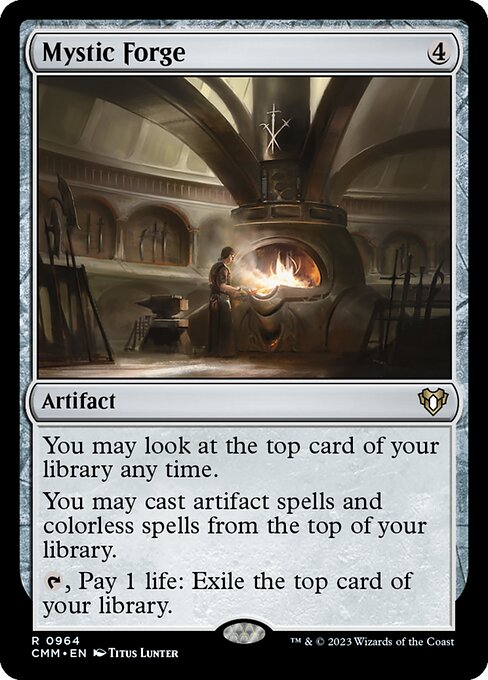
Mystic Forge

{4} · Artifact · Commander Masters (CMM)
3%
Live Inclusion
Times Brought
724
Decks Running
391
Median Cast Turn
6
Drawn → Played
65%
Format

33% of games where Mystic Forge resolved ended in a win for the caster, a +8.8 percentage-point lift over the 25% baseline when it stays in the library.

Mystic Forge sits in 3% of tracked Commander decks on Playgroup Live, a focused niche reflecting its true home: artifact-dense, colorless-heavy builds that want a repeatable stream of free casts off the top of the library. The 391 decks running it span 325 distinct players, with no single player accounting for more than a small slice of the data, which makes the signal unusually clean for a card at this inclusion level.

When Mystic Forge reaches the battlefield, 33% of those games convert to a win. Games where it never leaves the library close at 25%. That +8.8 percentage-point gap is directional and sits just above the lower confidence bound, so treat it as an early positive signal rather than a hard conclusion. The median first-cast turn is 6, consistent with a 4-mana permanent that typically needs a few turns of setup before it can be deployed and exploited.

The top-commander distribution tells the clearest story: Zhulodok, Szarekh, Ulalek, and a cluster of colorless or artifact-themed commanders dominate the inclusion list. Mystic Forge is not a generic good-stuff card. It earns its slot in decks that can reliably feed it artifact spells and colorless spells to chain off the top.

At a glance
  • 3% of tracked Commander decks include Mystic Forge
  • 65% of drawn copies were cast before the game ended
  • T6 median first-cast turn, one above its mana value
  • 79% battlefield stickiness once Mystic Forge resolves
  • 325 distinct players have brought Mystic Forge to a tracked game
  • +8.8 percentage-point win-rate lift over the library baseline (directional)

First-cast turn

n=107
1%
T1
2%
T2
7%
T3
14%
T4
18%
T5
49%
T6-9
9%
T10+
Median 6 P25 5 · P75 8 · max 13
On curve 24% (15 / 107 cast on T4) Cast same turn as drawn 39%

The "good card" funnel

724 brought · 325 players
Brought to game
724
Ever drawn
164
Reached battlefield
107
Still on board at game end
85
65%

Of 724 Mystic Forges brought to games, 164 were drawn, 107 of those were cast, and 79% of resolved copies remained on the battlefield through the end of the game.

≥ -0.3pp

Players who cast this card win 33% of the time (n=105) , vs 25% when it never left the library (n=486).

When players drew this card but left it in hand, they won 16% (n=51) — about the same as leaving it in the library. Those players survived long enough to draw it, so the gap above is about the card resolving, not just about surviving.

Observed gap +8.8pp; 95% confidence interval -0.3pp to +17.9pp. Correlational, not causal: powerful payoffs also get cast more often in games you are already winning.

Final zone distribution

196 instances
2.6%
Library
43.4%
Battlefield
20.9%
Graveyard
10.7%
Exile

The vast majority of Mystic Forge copies never leave the library, the expected structural result of a singleton in a 100-card deck. Among observed copies, the battlefield is the most common final resting place, consistent with the card's high stickiness once resolved.

Commanders that played this card

in tracked games

The commander list skews heavily toward colorless and artifact-tribal strategies. Szarekh, Zhulodok, and Ulalek each clear 20 decks, signaling that Mystic Forge is a specialist inclusion rather than a broadly adopted staple.

Frequently Asked

How often is Mystic Forge drawn and cast in a tracked Commander game?
Across 698 tracked multiplayer Commander games where Mystic Forge was in the deck, it was drawn 23% of the time. Of the 164 instances that reached a hand, 65% were cast before the game ended. The remainder were mostly a game-length effect: cards drawn in the late game often never resolve before the table reaches a conclusion.
What turn does Mystic Forge usually land on the battlefield?
Median first-cast turn is 6, with the 25th–75th percentile band running from turn 5 to turn 8. A handful of copies (3 in the distribution) hit on turn 1 via aggressive ramp, but the bulk of casts cluster in the mid-game. The card's 4-mana cost means most players need at least a turn of ramp or a lucky opening hand to deploy it ahead of curve.
Does casting Mystic Forge actually improve your odds of winning?
In 105 participations where Mystic Forge reached the battlefield, the caster won 33% of games. In 486 participations where it stayed in the library, the win rate was 25%. The +8.8 percentage-point gap is a positive directional signal. The sample size is sufficient to report, but the confidence interval just grazes zero on the low end, so read this as encouraging rather than conclusive.
Which commanders most commonly run Mystic Forge?
The top of the Playgroup Live list is led by Szarekh the Silent King, Zhulodok Void Gorger, and Ulalek Fused Atrocity, each with 20 or more decks in the tracked set. That pattern reflects Mystic Forge's core use case: commanders that generate large numbers of colorless or artifact spells and want the card-advantage engine the Forge provides. Commanders with restricted color identities that limit access to blue card draw are especially strong adopters.
Is Mystic Forge legal in Commander? What about other formats?
Mystic Forge is legal and unrestricted in Commander, which is the format this page focuses on. It is also legal in Legacy, Modern, Pioneer, Historic, Timeless, and Gladiator. It is restricted in Vintage, meaning only one copy is permitted in that format's decks. It is not legal in Standard, Pauper, or Pauper Commander.
How concentrated is the Mystic Forge data across players?
325 distinct players have brought Mystic Forge to at least one tracked game, and the heaviest single contributor accounts for only 23% of all instances. That spread is a strength of the dataset: no single player's preferences are skewing the numbers materially. You can read the win-rate and cast-turn figures as a reasonably cross-player signal rather than one pilot's results.