
collections_bookmark Part of Edge of Eternities

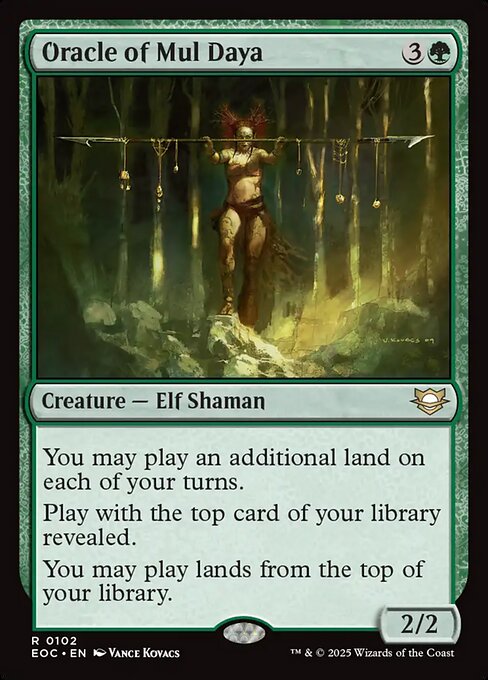
Oracle of Mul Daya card art
Live Play Data

Oracle of Mul Daya

{3} {G} · Creature — Elf Shaman · Edge of Eternities Commander (EOC)
5%
Live Inclusion
Times Brought
766
Decks Running
370
Median Cast Turn
5
Drawn → Played
65%
Format

5% of tracked Commander decks run Oracle of Mul Daya. When drawn, 65% of copies are cast, with a median first-cast turn of 5.

Oracle of Mul Daya sits in 5% of the 7200 tracked Commander decks on Playgroup Live, appearing across 370 distinct lists. The four-mana Elf Shaman offers an additional land drop each turn, top-of-library vision, and the ability to play lands directly from the top of the deck. That three-ability package puts it in the first tier of green ramp creatures.

When Oracle reaches a player's hand, 65% of those copies are cast before the game ends. Median first cast lands on turn 5, consistent with a card that players cast as soon as they have the mana. The same-turn cast rate of 39% reflects some hesitation: players evaluate the board before committing a four-mana creature, or simply lack the mana on the draw step. Once it resolves, 54% of cast copies remain on the battlefield at game's end, an early signal that removal pressure on Oracle is real but not overwhelming.

The commander spread is notably wide. 310 distinct players have brought Oracle to tracked games, and the single heaviest contributor accounts for just 24% of drawn instances. That breadth suggests Oracle earns its slot across many green archetypes, not just one dominant shell. Land-matters commanders such as Aesi, Azusa, and both Omnathen variants dominate the top-ten list, which is exactly the expected home for a card that accelerates land deployment.

At a glance
  • 5% of tracked Commander decks include Oracle of Mul Daya
  • 65% of drawn copies are cast before the game ends
  • T5 median first-cast turn across all observed games
  • 54% battlefield stickiness once cast
  • 310 distinct players have brought Oracle to a tracked game
  • 37% of casts land exactly on-curve at four mana

First-cast turn

n=121
2%
T1
6%
T2
15%
T3
14%
T4
20%
T5
40%
T6-9
3%
T10+
Median 5 P25 4 · P75 6 · max 14
On curve 37% (17 / 121 cast on T4) Cast same turn as drawn 39%

The "good card" funnel

770 brought · 310 players
Brought to game
770
Ever drawn
185
Reached battlefield
121
Still on board at game end
65
65%

Of 770 Oracle copies brought to games, 185 were drawn, 121 of those were cast, and 54% of resolved copies remained on the battlefield at game's end.

≥ -2.6pp

Players who cast this card win 31% of the time (n=109) , vs 25% when it never left the library (n=505).

When players drew this card but left it in hand, they won 39% (n=61) — about the same as leaving it in the library. Those players survived long enough to draw it, so the gap above is about the card resolving, not just about surviving.

Observed gap +5.9pp; 95% confidence interval -2.6pp to +14.3pp. Correlational, not causal: powerful payoffs also get cast more often in games you are already winning.

Final zone distribution

202 instances
4.5%
Library
32.2%
Battlefield
32.2%
Graveyard
7.4%
Exile

Most observed Oracle copies finish the game on the battlefield or graveyard, with very few stranded in the library. That low library-finish rate reflects how eagerly players cast it once it reaches their hand.

Commanders that played this card

in tracked games

Hearthhull, the Worldseed dominates the commander list by deck count, but ten different commanders appear in the top ten, showing Oracle earns its slot across a wide range of green shells rather than in one dominant archetype.

Frequently Asked

How often is Oracle of Mul Daya drawn in a Commander game?
In 734 tracked multiplayer Commander games where Oracle was in the deck, it was drawn 24% of the time. That is typical for a singleton in a 100-card deck. Of 185 instances that reached a hand, 65% were cast before the game concluded. The remainder were mostly drawn late in games that ended before the player could deploy a four-mana creature.
What turn does Oracle of Mul Daya usually hit the battlefield?
Median first cast is turn 5, with the middle 50% of casts falling between turns 4 and 6. The distribution has a small early cluster for players who drew it in the opening hand and accelerated into it, and a longer tail extending into the double-digit turns for copies drawn well into the mid-game. Only 37% of casts land exactly on turn four, mostly because many copies are drawn after the natural curve window has already passed.
Does casting Oracle of Mul Daya actually improve your win rate?
Games where Oracle was cast show a 31% win rate versus 25% in games where it stayed in the library, a gap of +5.9 percentage points. Both buckets have solid sample sizes (109 and 505 participations respectively), but the standard error is large enough that this is directional rather than conclusive. The signal is consistent with Oracle being a meaningful contributor, but the dataset is not large enough to call it proven.
Which commanders most commonly pair with Oracle of Mul Daya?
Hearthhull, the Worldseed leads the top-commander list by a wide margin, reflecting that deck's heavy land-synergy theme. Flubs, the Fool, Tifa Lockhart, Aesi, and Azusa round out the top five. Land-matters commanders dominate because Oracle's core value, playing an extra land each turn from the top of the deck, compounds directly with commanders that reward high land counts or repeated land drops.
Is Oracle of Mul Daya legal in Commander?
Yes. Oracle of Mul Daya is legal and unrestricted in Commander, as well as in Legacy, Modern, Vintage, Historic, Timeless, and several other formats. It is not legal in Standard, Pioneer, Pauper, or Pauper Commander. The card carries no ban or restriction in the Commander format as of its most recent Scryfall legality update.
How concentrated is Oracle of Mul Daya's data across players?
310 distinct players have contributed to Oracle's tracked dataset, and the single heaviest contributor accounts for a modest share of total instances. The data is well-spread, which adds confidence that the observed patterns reflect broad play tendencies rather than one player's specific habits or deck configuration.