collections_bookmark Part of Marvel Super Heroes
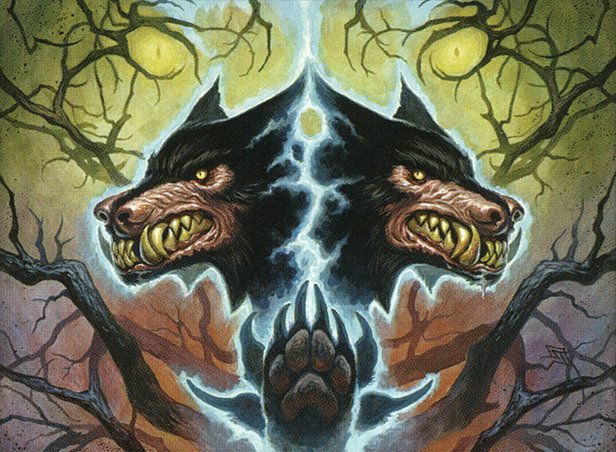
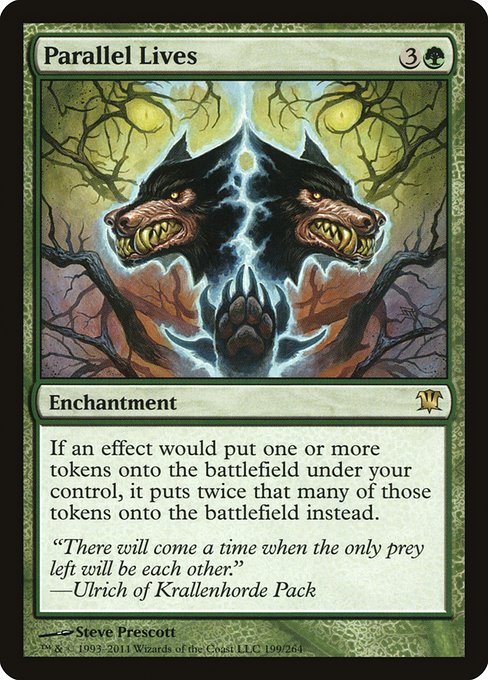
Parallel Lives card art
Live Play Data

Parallel Lives

{3} {G} · Enchantment · Innistrad (ISD)
6%
Live Inclusion
Times Brought
840
Decks Running
456
Median Cast Turn
6
Drawn → Played
71%
Format

6% of tracked Commander decks run Parallel Lives. When drawn, 71% of copies reach the battlefield, with a median first-cast turn of 6.

Parallel Lives sits in 456 of 7796 tracked Commander decks on Playgroup Live, a 6% inclusion rate that reflects its narrow but devoted home in token-doubling strategies. This is a build-around card, not a generalist staple, and the numbers show exactly that.

When a copy reaches a player's hand, 71% of the time it eventually resolves. The median first-cast turn is 6, a beat or two after the curve suggests. That delay is consistent with the card costing 4 mana in a color that often wants to develop its board before spending resources on an enchantment that pays off gradually. The 34% same-turn cast rate confirms that when players do hold it, they're waiting for the right moment rather than slamming it immediately.

The top-commander list is dominated by token-centric strategies: squirrel tribal, go-wide creature engines, and token-copying commanders. The card's 378 distinct players across the dataset is a meaningful breadth signal. This is not a one-player skew. It is a genuine niche staple with a wide, committed audience.

At a glance
  • 6% of tracked Commander decks include Parallel Lives
  • 71% of drawn copies reach the battlefield before the game ends
  • T6 median first-cast turn, a turn or two after the mana-value curve
  • 75% battlefield stickiness once the enchantment resolves
  • 378 distinct players have brought Parallel Lives to a tracked game
  • 34% same-turn cast rate when drawn, showing players tend to hold it briefly

First-cast turn

n=125
0%
T1
2%
T2
6%
T3
14%
T4
20%
T5
46%
T6-9
12%
T10+
Median 6 P25 5 · P75 8 · max 13
On curve 22% (17 / 125 cast on T4) Cast same turn as drawn 34%

The "good card" funnel

841 brought · 378 players
Brought to game
841
Ever drawn
177
Reached battlefield
125
Still on board at game end
94
71%

Of 841 copies brought to games, 177 were drawn, 125 of those were cast, and 75% of resolved copies remained on the battlefield through end of game.

≥ -8.1pp

Players who cast this card win 27% of the time (n=107) , vs 27% when it never left the library (n=570).

When players drew this card but left it in hand, they won 30% (n=47) — about the same as leaving it in the library. Those players survived long enough to draw it, so the gap above is about the card resolving, not just about surviving.

Observed gap +0.1pp; 95% confidence interval -8.1pp to +8.3pp. Correlational, not causal: powerful payoffs also get cast more often in games you are already winning.

Final zone distribution

190 instances
1.6%
Library
49.5%
Battlefield
15.3%
Graveyard
5.3%
Exile

Most Parallel Lives copies that finish in a non-library zone land on the battlefield or graveyard, reflecting both successful resolutions and the removal pressure enchantments face in a typical pod.

Commanders that played this card

in tracked games

The top-commander list skews heavily toward token doublers and go-wide engines, with squirrel tribal and creature-token commanders occupying the top slots consistently across both multiplayer and duel cuts.

Card text
Parallel Lives card

Parallel Lives

{3} {G}
Enchantment
If an effect would create one or more tokens under your control, it creates twice that many of those tokens instead.
Innistrad (ISD) · Rare · Illustrated by Steve Prescott

Frequently Asked

How often is Parallel Lives drawn in a Commander game?
Across 797 tracked games where Parallel Lives was in the deck, it was drawn 21% of the time. That is in line with expectations for a singleton in a 100-card deck. Of 177 instances that reached a player's hand, 71% were cast before the game ended. The remainder reflects games that concluded before the player found a good window to resolve it.
What turn does Parallel Lives typically hit the battlefield?
The median first-cast turn is 6, with the bulk of casts clustered between turns 5 and 8. The card costs 4 mana, but the on-curve rate of 22% is low, which is largely a draw-timing effect rather than players choosing to hold it. Most copies arrive after the opening hand window. The same-turn cast rate of 34% shows that players do wait a turn or two once they have it in hand.
Does casting Parallel Lives actually improve your win rate?
On Playgroup Live, the cast-vs-library delta for Parallel Lives is very small and well within statistical noise given the current sample size. The win rates when cast and when the card stays in the library are close enough that we treat the difference as directional at best. This does not mean the card is weak. It means our dataset is not yet large enough to isolate its contribution cleanly. The metric should be read as early signal only.
Which commanders play Parallel Lives most often?
Baylen, the Haymaker leads the multiplayer top-commanders list, followed by Rin and Seri, Inseparable and The Unbeatable Squirrel Girl. The pattern is consistent: go-wide token strategies in green or green-adjacent color identities. Chatterfang, Squirrel General and Xyris, the Writhing Storm also appear, reinforcing the card's identity as a doubler for engines that generate many tokens per trigger.
Is Parallel Lives legal in Commander?
Yes. Parallel Lives is legal in Commander and has never been placed on the format's ban list. It is also legal in Legacy, Modern, Vintage, Historic, and Timeless. It is not legal in Pioneer or Standard. In Commander, its color identity is mono-green, so it can only be included in decks whose commander has green in its color identity.
How concentrated is the Parallel Lives data across players?
The dataset spans 378 distinct players who have brought Parallel Lives to at least one tracked game. The single heaviest contributor accounts for only 4% of all instances, well below the threshold where one player's habits could skew the aggregate numbers. That spread gives the directional stats here more credibility than a thin or lopsided sample would.