collections_bookmark Part of Streets of New Capenna
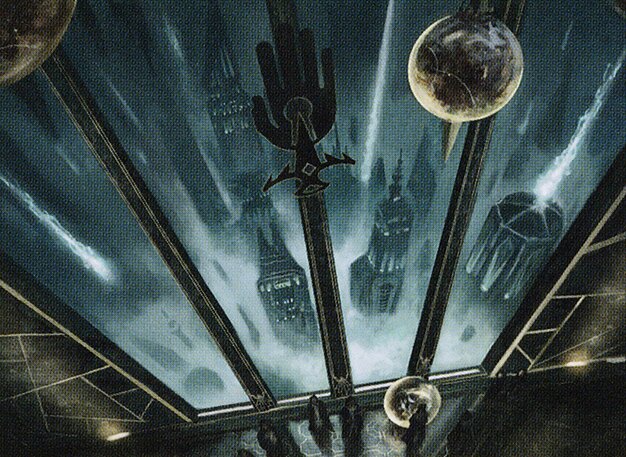
Raffine's Tower card art
Live Play Data

Raffine's Tower

Land — Plains Island Swamp · Streets of New Capenna (SNC)
19%
Live Inclusion
Times Brought
858
Decks Running
419
Median Cast Turn
3
Drawn → Played
80%
Format

Raffine's Tower appears in 19% of tracked Esper-accessible Commander decks on Playgroup Live, and 80% of drawn copies reach the battlefield, with a median first-cast turn of 3.

Raffine's Tower is the Esper triome from Streets of New Capenna, and it shows up in 19% of Commander decks tracked on Playgroup Live. That figure spans 419 of the 2159 distinct decks in the dataset, a consistent signal across 365 unique players with no single contributor exceeding 3% of instances.

Lands play differently from spells. Raffine's Tower enters tapped, which costs a tempo point on the turn it's played, but the cycling outlet at {3} means a late-game copy is never truly dead. 80% of drawn copies end up on the battlefield before the game closes, and the median first-cast turn is 3. The hand-to-cast data backs this up: players who draw it typically play it quickly, with 74% of drawn-and-cast instances landing on the same turn they were drawn.

The commander distribution skews heavily toward Esper (White-Blue-Black) shells, where Raffine's Tower is a strict fixing upgrade over basic lands. Four-color and five-color decks also appear in the top commanders, picking up the Tower as a flexible triome that covers three of their colors simultaneously.

At a glance
  • 19% of tracked Commander decks include Raffine's Tower
  • 80% of drawn copies reach the battlefield before the game ends
  • T3 median first-cast turn across tracked games
  • 74% of drawn-and-cast copies played on the same turn they were drawn
  • 89% battlefield stickiness once the Tower resolves
  • 365 unique players have brought Raffine's Tower to a tracked game

First-cast turn

n=245
38%
T1
9%
T2
10%
T3
5%
T4
10%
T5
22%
T6-9
5%
T10+
Median 3 P25 1 · P75 6 · max 16
Cast same turn as drawn 74%

The "good card" funnel

858 brought · 365 players
Brought to game
858
Ever drawn
306
Reached battlefield
245
Still on board at game end
218
80%

Of 858 Raffine's Towers brought to games, 306 were drawn, 245 of those were cast, and the large majority stayed on the battlefield through the end of the game.

≥ +2.6pp

Players who cast this card win 34% of the time (n=230) , vs 25% when it never left the library (n=460).

When players drew this card but left it in hand, they won 30% (n=56) — about the same as leaving it in the library. Those players survived long enough to draw it, so the gap above is about the card resolving, not just about surviving.

Observed gap +9.2pp; 95% confidence interval +2.6pp to +15.8pp. Correlational, not causal: powerful payoffs also get cast more often in games you are already winning.

Final zone distribution

329 instances
4.6%
Library
66.3%
Battlefield
13.1%
Graveyard
4.6%
Exile

The vast majority of Raffine's Towers that enter the battlefield stay there, a reflection of how rarely opponents prioritize destroying a tapped triome. Copies in the graveyard largely represent cycled instances trading late-game tempo for a fresh draw.

Commanders that played this card

in tracked games

The commander list skews heavily Esper, with Y'shtola, Night's Blessed and Jin Sakai, Ghost of Tsushima leading the pack. The distribution across 365 unique players and no dominant single contributor suggests broad, format-wide adoption rather than a few players inflating the numbers.

Card text
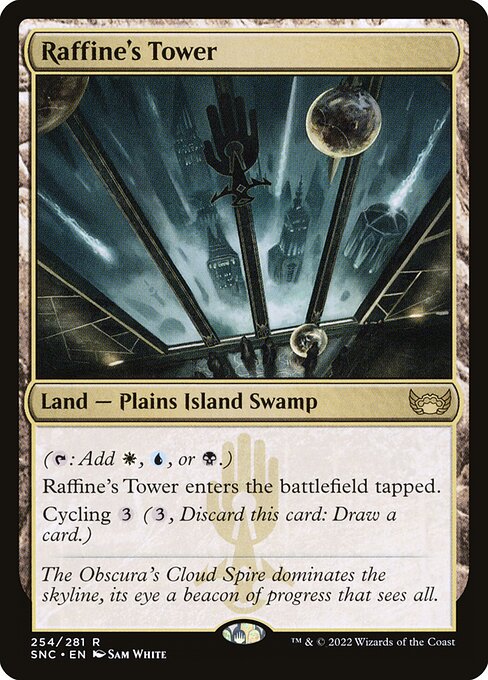
Raffine's Tower card

Raffine's Tower

Land — Plains Island Swamp
({T}: Add {W}, {U}, or {B}.) This land enters tapped. Cycling {3} ({3}, Discard this card: Draw a card.)

Streets of New Capenna (SNC) · Rare · Illustrated by Sam White

Frequently Asked

How often is Raffine's Tower drawn in a Commander game?
In 820 tracked multiplayer Commander games where Raffine's Tower was in the deck, it was drawn 36% of the time. That is a somewhat elevated draw rate for a singleton land, partly because many Esper decks run tutors and card selection that can find it. Of the 306 instances that reached a player's hand, 80% were cast before the game ended.
What turn does Raffine's Tower typically hit the battlefield?
Median first-cast turn is 3. The distribution shows a strong cluster on turn 1, driven by opening-hand keeps, and then a long tail through the mid-game. The p75 sits at turn 6, meaning most casts happen in the first six turns. Late-game copies that would be dead draws can be cycled for {3} instead, which helps keep the effective utility high.
Does casting Raffine's Tower correlate with winning?
In 230 participations where the Tower reached the battlefield, the normalized win rate is 34%, compared to 25% in the 460 participations where it stayed in the library. That is a +9.2 percentage-point gap. Both buckets are reasonably sized, but the delta is directional rather than conclusive at this sample size. Decks with better mana fixing tend to be better-constructed overall, so some of this lift reflects deck quality rather than the Tower itself.
Is Raffine's Tower banned anywhere relevant to Commander?
Raffine's Tower is legal in Commander, Legacy, Modern, Pioneer, Vintage, Historic, Duel Commander, and Oathbreaker. It is not legal in Standard, Pauper, or Pauper Commander. There are no current bans or restrictions that affect its Commander play.
Which commanders run Raffine's Tower most often?
The top commanders in Playgroup Live's dataset are strongly skewed toward Esper (White-Blue-Black) identities. Y'shtola, Night's Blessed leads with the most decks, followed by Jin Sakai, Ghost of Tsushima and Oloro, Ageless Ascetic. Four-color and five-color commanders also appear, using the Tower as a triome that covers White, Blue, and Black simultaneously. This spread across many distinct commanders confirms the card is a format-wide mana-fixing choice rather than a niche pick for one archetype.
Why run Raffine's Tower over a basic land?
Raffine's Tower taps for any of three colors, covering the entire Esper color identity from a single card. It enters tapped, which is the main cost. In Commander's slower, 40-life format, one turn of tempo loss in the early game is generally acceptable for guaranteed three-color fixing. The cycling clause at {3} adds a meaningful late-game safety valve: a redundant land drawn after your mana base is complete can be discarded to draw a fresh card rather than sitting inert in hand.