

Takenuma, Abandoned Mire
72% of drawn Takenuma copies are channeled or played before the game ends, with a median first-cast turn of 5 across 1162 tracked multiplayer games on Playgroup Live.
Takenuma, Abandoned Mire shows up in 8% of tracked Commander decks on Playgroup Live, appearing in 693 of 8560 distinct decks. When a copy reaches a player's hand, it is cast or channeled 72% of the time before the game concludes.
The card's dual nature as both a black mana source and a graveyard-recursion channel makes the draw-to-play figure particularly meaningful. A player holding Takenuma has the option to play it as a land or discard it as a channel activation, so copies sitting idle in hand are rarer than with a pure spell. The median first-cast turn of 5 reflects that channel activations often come mid-game, when a relevant creature or planeswalker has already hit the graveyard. Half of the same-turn-cast rate of 47% suggests many players deploy it immediately upon drawing, while others hold it for the right recursion target.
The commander spread across 514 unique players is wide, and the single heaviest contributor accounts for only 3% of all tracked instances. That breadth is an early signal that Takenuma is a genuine format staple rather than a pet card of one active user. It slots into any black shell that runs legendary creatures, and the discount mechanic rewards densely legendary lists like Edgar Markov or K'rrik, Son of Yawgmoth.
- 8% of tracked Commander decks include Takenuma, Abandoned Mire
- 72% of drawn copies reach play before the game ends
- T5 median first-cast (or channel activation) turn
- 47% of drawn copies are deployed the same turn they are drawn
- 81% battlefield stickiness when played as a land
- 514 distinct players have brought Takenuma to a tracked game
First-cast turn
n=231The "good card" funnel
1269 brought · 514 playersOf 1269 Takenuma copies brought to games, 322 were drawn, and 231 of those were cast or channeled before the game ended, a strong completion rate for a land-channel hybrid.
Players who cast this card win 22% of the time (n=208) , vs 24% when it never left the library (n=755).
When players drew this card but left it in hand, they won 28% (n=84) — about the same as leaving it in the library. Those players survived long enough to draw it, so the gap above is about the card resolving, not just about surviving.
Observed gap -1.9pp; 95% confidence interval -7.9pp to +4.1pp. Correlational, not causal: powerful payoffs also get cast more often in games you are already winning.
Final zone distribution
376 instancesMost Takenuma copies finish on the battlefield as a land or in the graveyard after a channel activation. The near-zero library count shows that once a copy is observed in hand, it almost always finds a use before the game concludes.
Commanders that played this card
in tracked games-
1
Edgar Markov


 18 decks
-
2
Teval, the Balanced Scale

 18 decks
-
3
Henzie "Toolbox" Torre
17 decks
-
4
The Necrobloom
10 decks
-
5
Hearthhull, the Worldseed
9 decks
-
6
K'rrik, Son of Yawgmoth
9 decks
-
7
The Serpent Society
9 decks
-
8
The Wise Mothman
9 decks
-
9
Yuriko, the Tiger's Shadow
9 decks
-
10
Captain N'ghathrod
8 decks
The commander list spans a wide range of archetypes and color identities, from vampire tribal Edgar Markov to graveyard-value Henzie, reflecting that Takenuma slots into any black deck with legendary density rather than one specific shell.
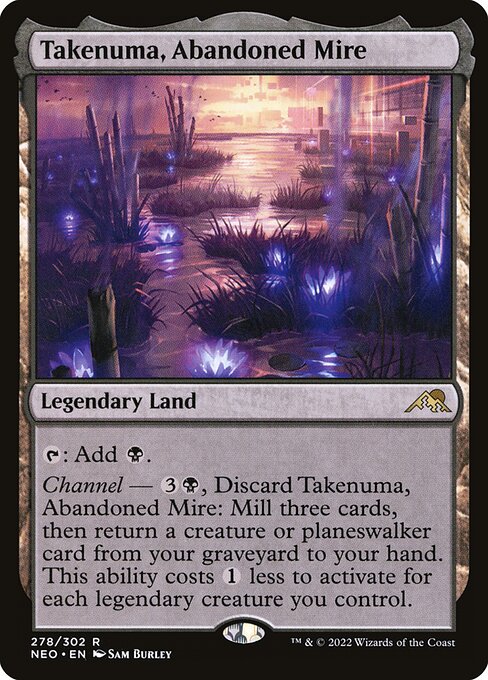
Takenuma, Abandoned Mire
 : Add .
Channel —
: Add .
Channel —  , Discard this card: Mill three cards, then return a creature or planeswalker card from your graveyard to your hand. This ability costs
  less to activate for each legendary creature you control.