collections_bookmark Part of Bloomburrow

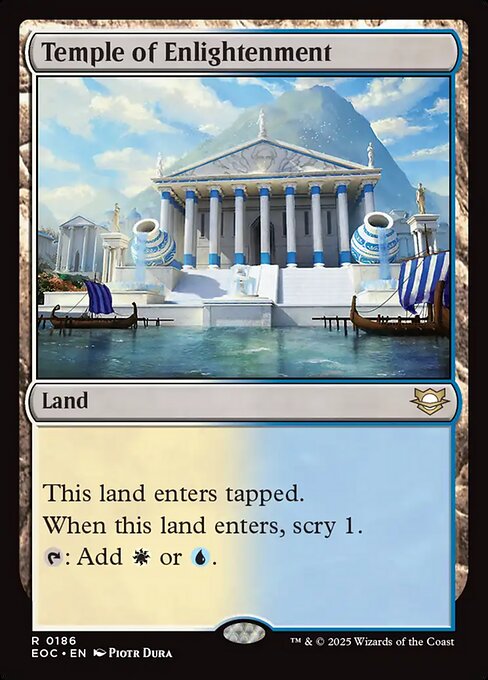
Temple of Enlightenment card art
Live Play Data

Temple of Enlightenment

Land · Edge of Eternities Commander (EOC)
16%
Live Inclusion
Times Brought
1543
Decks Running
744
Median Cast Turn
3.0
Drawn → Played
73%
Format

16% of tracked Commander decks in white-blue color identities run Temple of Enlightenment. When drawn, it reaches the battlefield 73% of the time, with a median first-play turn of 3.0.

Temple of Enlightenment sits in 16% of the 4759 Commander decks tracked on Playgroup Live, appearing across 744 distinct lists. That reach, spread across 647 unique players with no single contributor accounting for more than a small slice, suggests genuine broad adoption rather than a single playgroup's preference.

The card's appeal is straightforward: it enters tapped, so the mana tempo cost is real, but the scry 1 on entry lets you smooth your next draw. 73% of drawn copies reach the battlefield before the game ends, which is consistent with players treating it as a land they want to play promptly. Median first play lands on turn 3.0, and a notable cluster hits on turn 1 from opening hands. Once in play, it sticks: 97% stickiness, as expected for a basic-land-adjacent permanent with no inherent removal magnet.

Temple of Enlightenment is legal in Commander, Legacy, Pioneer, Modern, and most other constructed formats. It is not legal in Pauper or Pauper Commander due to its rare printing. Within Commander it fills a role as a budget-accessible scry land for any deck running white and blue.

At a glance
  • 16% of tracked Commander decks include Temple of Enlightenment
  • 24% draw rate across tracked games, normal for a singleton in a 100-card deck
  • 73% of drawn copies reach the battlefield before the game ends
  • T3.0 median first-play turn
  • 97% battlefield stickiness once played
  • 647 unique players have brought this card to a tracked game

First-cast turn

n=276
33%
T1
14%
T2
9%
T3
8%
T4
5%
T5
25%
T6-9
7%
T10+
Median 3.0 P25 1 · P75 6 · max 22
Cast same turn as drawn 65%

The "good card" funnel

1543 brought · 647 players
Brought to game
1543
Ever drawn
377
Reached battlefield
276
Still on board at game end
267
73%

Of 1543 copies brought to tracked games, 377 were drawn, 276 of those were played before the game ended, and the overwhelming majority stayed on the battlefield through end of game.

≥ +0.6pp

Players who cast this card win 27% of the time (n=246) , vs 21% when it never left the library (n=981).

When players drew this card but left it in hand, they won 33% (n=92) — about the same as leaving it in the library. Those players survived long enough to draw it, so the gap above is about the card resolving, not just about surviving.

Observed gap +6.3pp; 95% confidence interval +0.6pp to +12.0pp. Correlational, not causal: powerful payoffs also get cast more often in games you are already winning.

Final zone distribution

419 instances
1.4%
Library
63.7%
Battlefield
15.5%
Graveyard
2.9%
Exile

The vast majority of Temple of Enlightenment copies never leave the library, which is expected for any singleton land in a 100-card deck. The copies that do get seen end up on the battlefield at a high rate, with only a small fraction stranded in hand or sent to the graveyard.

Commanders that played this card

in tracked games

The commander list skews heavily toward white-blue and Jeskai commanders, which is exactly what you expect for a land gated to white and blue mana. Ms. Bumbleflower and Tidus lead by deck count, but the spread across ten distinct commanders shows Temple slots into many strategies.

Card text
Temple of Enlightenment card

Temple of Enlightenment

Land
This land enters tapped. When this land enters, scry 1. (Look at the top card of your library. You may put that card on the bottom.) {T}: Add {W} or {U}.

Edge of Eternities Commander (EOC) · Rare · Illustrated by Piotr Dura

Frequently Asked

How often is Temple of Enlightenment drawn in a Commander game?
Across 1447 tracked games where Temple of Enlightenment was in the deck, it was drawn 24% of the time. That is roughly what you expect from a singleton land in a 100-card deck. Of 377 instances that reached a hand, 73% were played before the game ended.
What turn does Temple of Enlightenment usually hit the battlefield?
Median first-play turn is 3.0. The distribution is front-loaded: the single most common play turn is turn 1, reflecting copies kept in opening hands. The interquartile range runs from turn 1 to turn 6, meaning the bulk of casts happen early and the card rarely sits in hand for long. The same-turn play rate is 65%, confirming players tend to play it the turn they draw it rather than holding it.
Does playing Temple of Enlightenment actually improve your win rate?
This is directional data, not a definitive finding. Participations where the card was cast show a win rate of 27% across 246 observations. Games where it stayed in the library show 21% across 981 observations. The delta is +6.3 percentage points. Both sample sizes are meaningful but not large enough to rule out noise. Treat this as an early signal that resolved copies correlate with winning decks, not a proven causal claim.
Is Temple of Enlightenment banned anywhere?
Temple of Enlightenment is legal in Commander, Legacy, Modern, Pioneer, Standard, Historic, Vintage, and most other formats. It is not legal in Pauper or Pauper Commander due to its rare rarity. It is also not legal in Old School or Premodern, which predate its printing. There are no current bans in Commander.
Which commanders most commonly run Temple of Enlightenment?
The top commanders on Playgroup Live are Ms. Bumbleflower, Tidus Yuna's Guardian, and Zinnia Valley's Voice, each with the white-blue or white-blue-green color identities that make the land eligible. The spread across the top-ten list is wide, with deck counts ranging from the mid-thirties down to single digits, suggesting the card sees play across many archetypes rather than being locked into one commander.
How concentrated is the Temple of Enlightenment data among players?
The data comes from 647 distinct players, and no single player accounts for more than a small fraction of tracked instances. The max single-player share is under 4%, which is a healthy spread for a dataset of this size. That makes the aggregate numbers more representative of the broader playgroup population than a card dominated by one or two heavy contributors.