collections_bookmark Part of Bloomburrow
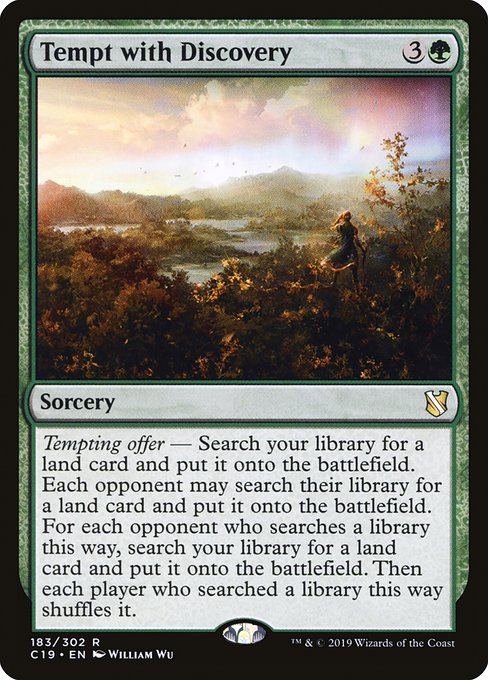
Tempt with Discovery card art
Live Play Data

Tempt with Discovery

{3} {G} · Sorcery · Commander 2019 (C19)
4%
Live Inclusion
Times Brought
613
Decks Running
296
Median Cast Turn
6.0
Drawn → Played
64%
Format

31% of games where Tempt with Discovery resolved ended in a win for the caster, a +13.3 percentage-point lift over the 18% baseline seen when the card never left the library.

Tempt with Discovery sits in 4% of tracked Commander decks on Playgroup Live, a niche but deliberate slot that shows up most heavily in group-hug and five-color shells. Across 600 tracked games, the card has been cast 100 times, giving us a meaningful window into how the Tempting Offer mechanic actually plays out at the table.

The win-rate signal here is one of the cleaner ones we track. Decks that cast Tempt with Discovery win at 31%, compared to 18% in participations where the card sat untouched in the library. That +13.3-point gap clears the lower bound of our confidence interval, which is an early but consistent signal that resolving this spell correlates with better game outcomes. Sample sizes are in the dozens, so treat it as directional rather than definitive.

The mechanic rewards opponents who take the bait. In a typical 4-player pod, each opponent who searches hands the caster an additional land fetch. Players appear to read this correctly: median first cast lands on turn 6.0, well into the midgame when the extra lands compound faster. The commander spread is broad, with 273 distinct players contributing data and the single heaviest contributor accounting for just 2% of instances, which suggests the sample is not dominated by any one playgroup's habits.

At a glance
  • 4% of tracked Commander decks include Tempt with Discovery
  • 64% of drawn copies reach the cast step before the game ends
  • T6.0 median first-cast turn, deep into the midgame
  • 31% win rate in games where the spell resolved
  • +13.3pp win-rate lift over games where it stayed in the library
  • 273 distinct players have brought this card to a tracked game

First-cast turn

n=100
1%
T1
2%
T2
11%
T3
19%
T4
15%
T5
46%
T6-9
6%
T10+
Median 6.0 P25 4 · P75 8 · max 12
On curve 33% (19 / 100 cast on T4) Cast same turn as drawn 33%

The "good card" funnel

616 brought · 273 players
Brought to game
616
Ever drawn
157
Reached battlefield
100
Still on board at game end
4
64%

Of 616 copies brought to tracked games, 157 were drawn, 100 of those were cast, and the overwhelming majority resolved into the graveyard as expected for a sorcery.

≥ +3.8pp

Players who cast this card win 31% of the time (n=96) , vs 18% when it never left the library (n=393).

When players drew this card but left it in hand, they won 31% (n=54) — about the same as leaving it in the library. Those players survived long enough to draw it, so the gap above is about the card resolving, not just about surviving.

Observed gap +13.3pp; 95% confidence interval +3.8pp to +22.7pp. Correlational, not causal: powerful payoffs also get cast more often in games you are already winning.

Final zone distribution

169 instances
4.1%
Library
2.4%
Battlefield
62.7%
Graveyard
5.3%
Exile

Most Tempt with Discovery copies end up in the graveyard after resolving, which is exactly right for a sorcery: the zone distribution here reflects how often it was cast rather than how sticky it is.

Commanders that played this card

in tracked games

The commander list skews heavily toward group-hug and political archetypes, with Ms. Bumbleflower, Kynaios and Tiro, and Gluntch leading by deck count, a distribution that mirrors the card's inherent table-politics design.

Frequently Asked

How often is Tempt with Discovery drawn and cast in a Commander game?
Across 600 tracked games, Tempt with Discovery was drawn 25% of the time, consistent with a singleton in a 100-card deck. Of 157 instances that reached a player's hand, 64% were cast before the game ended. The rest were held in hand when the game concluded or were otherwise never activated. Median hand-to-cast delay is 1 turn, so most casters move on it quickly once they draw it.
What turn does Tempt with Discovery usually get cast?
Median first-cast turn is 6.0, with the interquartile range spanning turns 4 through 8. That midgame timing makes sense: at four mana, the card is castable in the early turns, but players tend to wait until they can extract the most value from the Tempting Offer trigger. Only 33% of casts landed exactly on curve (turn 4), with most instances cast later, reflecting both when the card is drawn and deliberate timing decisions.
Does casting Tempt with Discovery actually help you win?
The data is directional rather than conclusive at this sample size, but the signal points firmly positive. Participations where Tempt with Discovery was cast show a 31% win rate (n=96), against 18% for participations where it never left the library (n=393). The +13.3-point gap is meaningful, and the lower bound of the one-sided confidence interval sits above zero. Both buckets have enough observations to take the trend seriously.
Is Tempt with Discovery legal in Commander?
Yes. Tempt with Discovery is legal in Commander, Duel Commander, Legacy, Vintage, and Oathbreaker. It is not legal in Standard, Pioneer, Modern, Pauper, Historic, or Brawl. Notably, it was originally printed in Commander 2019 and has been a staple of group-hug and ramp strategies in the format ever since.
Which commanders most commonly run Tempt with Discovery?
The Playgroup Live dataset shows Ms. Bumbleflower leading the pack by raw deck count, followed by Kynaios and Tiro of Meletis and Gluntch, the Bestower. This clustering around group-hug commanders is thematically fitting: the Tempting Offer mechanic gives opponents a choice, which aligns with the political and cooperative identity of those strategies. Five-color commanders like Child of Alara and Kenrith also appear, reflecting the card's value in high-land-count, multicolor goodstuff shells.
Is the data on Tempt with Discovery concentrated around one playgroup?
No. The 273 distinct players who have brought Tempt with Discovery to a tracked game is among the broader spreads we see for a niche rare. The single heaviest contributor accounts for just 2% of all instances, well below the 15% threshold where concentration becomes a concern. That spread adds confidence to the directional win-rate signal.