collections_bookmark Part of Fallout
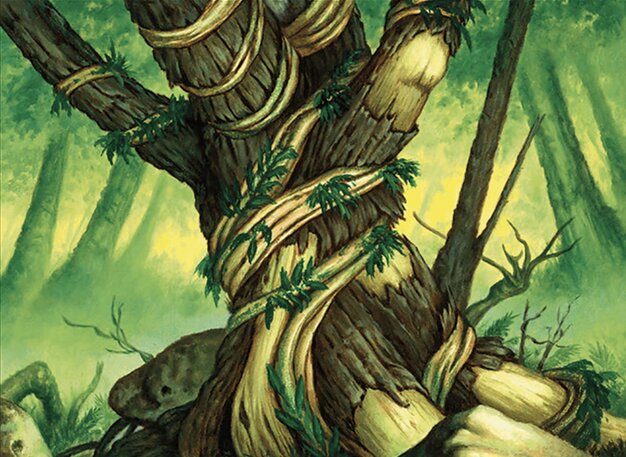
Wild Growth card art
Live Play Data

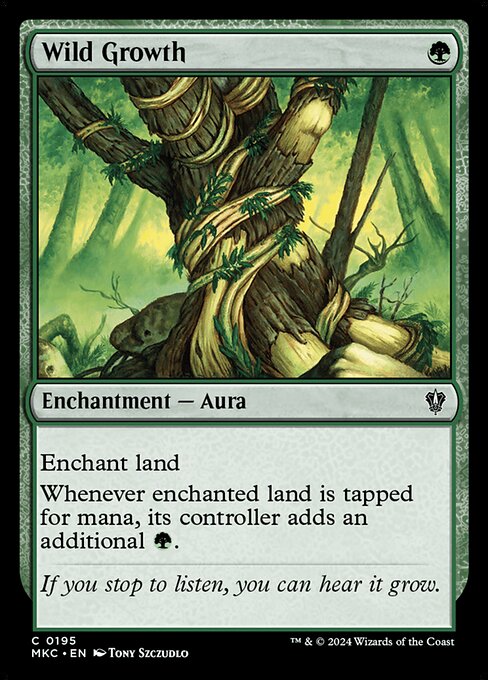
Wild Growth

{G} · Enchantment — Aura · Murders at Karlov Manor Commander (MKC)
9%
Live Inclusion
Times Brought
651
Decks Running
333
Median Cast Turn
3.0
Drawn → Played
73%
Format

73% of drawn Wild Growths are cast before the game ends, and the median first-cast turn lands on turn 3.0, making it one of the faster mana accelerators tracked on Playgroup Live.

Wild Growth sits in 9% of tracked Commander decks on Playgroup Live, appearing in 333 of the 3756 distinct decks that have played a tracked game. For a one-mana green Aura that simply turns any land into a dual producer, that reach is a quiet statement about how much green ramp strategies value cheap, reliable acceleration.

The draw-to-play rate is the sharpest signal here. 73% of drawn copies reach the battlefield, and 67% of those are cast the same turn they are drawn. That snap-cast behavior is consistent with how players treat one-mana ramp: if you have it, you play it. The median first cast lands on turn 3.0, well ahead of most enchantments in the format. Once it resolves, 85% of copies are still attached at the end of the game.

Wild Growth is legal in Commander, Pauper Commander, Duel Commander, Legacy, Vintage, and several older formats. It is not legal in Modern, Pioneer, Standard, or Brawl. Its single green mana identity keeps it in mono-green and Gruul shells most often, though any green commander can run it as a budget alternative to Utopia Sprawl or Fertile Ground.

At a glance
  • 9% of tracked Commander decks include Wild Growth
  • 73% of drawn copies are cast before the game ends
  • T3.0 median first-cast turn
  • 67% of cast copies were played the same turn they were drawn
  • 85% battlefield stickiness once cast
  • 282 distinct players have brought Wild Growth to a tracked game

First-cast turn

n=128
27%
T1
16%
T2
15%
T3
5%
T4
13%
T5
20%
T6-9
5%
T10+
Median 3.0 P25 1 · P75 5 · max 12
On curve 27% (34 / 128 cast on T1) Cast same turn as drawn 67%

The "good card" funnel

651 brought · 282 players
Brought to game
651
Ever drawn
175
Reached battlefield
128
Still on board at game end
110
73%

Of 651 Wild Growths brought to games, 175 were drawn, 128 of those were cast, and the large majority remained on the battlefield through end of game.

≥ -4.8pp

Players who cast this card win 28% of the time (n=125) , vs 25% when it never left the library (n=428).

When players drew this card but left it in hand, they won 27% (n=47) — about the same as leaving it in the library. Those players survived long enough to draw it, so the gap above is about the card resolving, not just about surviving.

Observed gap +3.4pp; 95% confidence interval -4.8pp to +11.6pp. Correlational, not causal: powerful payoffs also get cast more often in games you are already winning.

Final zone distribution

190 instances
1.6%
Library
57.9%
Battlefield
18.4%
Graveyard
3.7%
Exile

Most tracked Wild Growth instances finish on the battlefield or in the graveyard after land destruction. The library count is low relative to total instances, reflecting how consistently the card is found and played when present.

Commanders that played this card

in tracked games

The commander list spans mono-green, Gruul, and five-color builds, with no single commander dominating. That spread across 282 distinct players suggests Wild Growth earns its slot on merit across many archetypes rather than riding one popular shell.

Frequently Asked

How often is Wild Growth drawn in a Commander game?
Across 601 tracked games where Wild Growth was in the deck, it was drawn 27% of the time. That is consistent with singleton rates in a 100-card deck. Of 175 instances that reached a player's hand, 73% were cast before the game ended. The remainder is largely a game-length effect: copies drawn late in long games often do not find a window to resolve.
What turn does Wild Growth usually get cast?
Median first-cast turn is 3.0. The distribution clusters heavily at turn 1, reflecting copies kept in opening hands, with a secondary spread across turns 2-5. Turn 1 casts made up the single largest bucket in the distribution, consistent with players prioritizing early mana development. 27% of first casts landed exactly on curve for this 1-mana card.
Does casting Wild Growth actually improve your win rate?
When Wild Growth resolved, the caster won 28% of games in that sample of 125 participations. When Wild Growth stayed in the library the entire game, the win rate was 25% across 428 participations. That is a +3.4 percentage-point gap. With 125 cast observations, this is an early directional signal rather than a conclusive finding, and the confidence interval includes zero. Read it as consistent with the card pulling its weight, not proof.
Is Wild Growth legal in Commander?
Yes. Wild Growth is legal and unrestricted in Commander, Duel Commander, Pauper Commander, Legacy, Vintage, Oathbreaker, and several legacy formats including PreDH and Premodern. It is not legal in Modern, Pioneer, Standard, Historic, Brawl, or Alchemy. Its low mana cost and common rarity make it especially relevant in budget and Pauper Commander builds.
Which commanders run Wild Growth most often?
Across tracked games, Henzie "Toolbox" Torre, Shroofus Sproutsire, and The Unbeatable Squirrel Girl appear at the top of the commander distribution. The spread across 282 unique players with a maximum single-player share of 27% suggests no one pilot is driving the numbers. The card sees genuine adoption across Gruul, mono-green, and five-color builds.
How sticky is Wild Growth once it resolves?
85% of resolved Wild Growths are still attached to a land at the end of the game. Enchantment removal is less common in most Commander pods than creature removal, which partly explains the high persistence. The card does go to the graveyard when its enchanted land is destroyed, so the stickiness figure reflects the real-world resilience players experience rather than a theoretical ceiling.