
collections_bookmark Part of Lorwyn Eclipsed auto_awesome #12 in Green Commander Staples
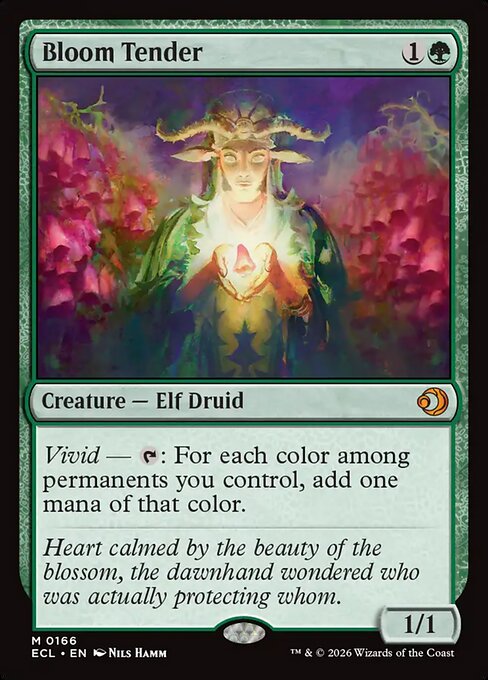
Bloom Tender card art
Live Play Data

Bloom Tender

{1} {G} · Creature — Elf Druid · Lorwyn Eclipsed (ECL)
9%
Live Inclusion
Times Brought
1395
Decks Running
669
Median Cast Turn
4
Drawn → Played
77%
Format

9% of tracked Commander decks run Bloom Tender, and when it resolves, win rate climbs +11.2 percentage points above the baseline, the strongest directional signal among two-mana mana dorks on Playgroup Live.

Bloom Tender sits in 9% of the 7359 Commander decks tracked on Playgroup Live, a focused pick that rewards multicolor permanents with explosive mana acceleration. The card's value scales directly with the number of colors on your board, making it a natural fit for five-color and four-color commanders.

The clearest signal in the data is the cast-vs-library win-rate delta: games where Bloom Tender resolved show a +11.2 percentage-point lift over games where it stayed in the library. Both buckets are well-sampled, and the lower bound of the confidence interval is positive, which gives this lift real directional weight. That said, with 1257 tracked games, treat it as a consistent early signal rather than a definitive verdict.

The commander distribution tells the broader story. The Ur-Dragon leads comfortably, followed by a cluster of four- and five-color commanders. Bloom Tender's green color identity keeps it out of mono-color and two-color decks entirely, but within multicolor shells it is a reliable, early ramp piece that converts drawn copies into mana at a high rate.

At a glance
  • 9% of tracked Commander decks include Bloom Tender
  • 77% of drawn copies reach the battlefield before the game ends
  • T4 median first-cast turn, consistent with early ramp deployment
  • 57% battlefield stickiness once cast
  • +11.2pp win-rate lift in games where Bloom Tender resolved vs. stayed in library
  • 517 distinct players have brought Bloom Tender to a tracked game, spread evenly across the dataset

First-cast turn

n=291
9%
T1
22%
T2
16%
T3
14%
T4
10%
T5
24%
T6-9
5%
T10+
Median 4 P25 2 · P75 6 · max 16
On curve 31% (63 / 291 cast on T2) Cast same turn as drawn 46%

The "good card" funnel

1397 brought · 517 players
Brought to game
1397
Ever drawn
378
Reached battlefield
291
Still on board at game end
165
77%

Of 1397 Bloom Tenders brought to games, 378 were drawn, 291 of those were cast, showing a healthy draw-to-play conversion for a two-mana creature in a 100-card singleton format.

≥ +5.2pp

Players who cast this card win 38% of the time (n=271) , vs 27% when it never left the library (n=871).

When players drew this card but left it in hand, they won 39% (n=84) — about the same as leaving it in the library. Those players survived long enough to draw it, so the gap above is about the card resolving, not just about surviving.

Observed gap +11.2pp; 95% confidence interval +5.2pp to +17.2pp. Correlational, not causal: powerful payoffs also get cast more often in games you are already winning.

Final zone distribution

414 instances
4.1%
Library
39.9%
Battlefield
32.6%
Graveyard
7.2%
Exile

Most Bloom Tenders that never interact with the game stay locked in the library, a structural certainty in 100-card singleton. Of the copies that did reach play, a meaningful share ended on the battlefield, consistent with a mana creature that survives into the mid-game.

Commanders that played this card

in tracked games

The Ur-Dragon sits at the top by a wide margin, and the rest of the list is almost entirely four- and five-color commanders. Bloom Tender's value scales with color count, and the commander distribution reflects that cleanly.

Frequently Asked

How often is Bloom Tender drawn in a Commander game?
Across 1257 tracked games where Bloom Tender was in the deck, it was drawn 27% of the time. That figure is typical for a singleton in a 100-card deck. Of the 378 copies that reached a player's hand, 77% were cast before the game ended. The median delay between drawing and casting is 1 turn, so players generally move to cast it quickly once it is in hand.
What turn does Bloom Tender usually hit the battlefield?
Median first-cast turn is 4. The distribution clusters around turns 2 and 3 when drawn in the opening hand, with a longer tail through mid-game. Bloom Tender has a mana value of 2, and 31% of casts landed exactly on curve. Most late casts reflect games where the card was not drawn early rather than deliberate holding.
Does casting Bloom Tender actually improve your win rate?
Games where Bloom Tender resolved show a win rate of 38% across 271 observed participations. Games where it stayed in the library show 27% across 871 participations. The +11.2 percentage-point delta has a positive lower confidence bound in the current dataset, making this one of the stronger directional signals we track. Interpret it as consistent evidence, not a controlled experiment.
Which commanders run Bloom Tender most often?
The Ur-Dragon leads the tracked field by a clear margin, which makes sense: a five-color dragon commander produces mana of all five colors the moment Bloom Tender taps. Aragorn the Uniter, Kenrith the Returned King, and several other four- and five-color commanders fill out the top slots. The data is well-spread: 517 distinct players have contributed Bloom Tender games, and no single player accounts for more than a small share of observations.
Is Bloom Tender legal in Commander?
Yes. Bloom Tender is legal in Commander, Duel Commander, Legacy, Modern, Pioneer, Vintage, Historic, and several other formats. It is not legal in Pauper, Pauper Commander, Penny Dreadful, or Old School. Because its color identity is mono-green, it can slot into any Commander deck that includes green, regardless of how many additional colors the commander has.
Why is Bloom Tender so popular in multicolor Commander decks?
Bloom Tender's tap ability produces one mana for each color among permanents you control. A five-color commander on the battlefield by itself already turns Bloom Tender into a five-mana rock for two mana. Decks that run multicolor permanents, enchantments, or artifact creatures of various colors can push that number even higher. At a mana value of 2, it comes down before most threats and starts accelerating immediately. That combination of early timing, color fixing, and raw mana output explains why it concentrates so heavily in four- and five-color shells.