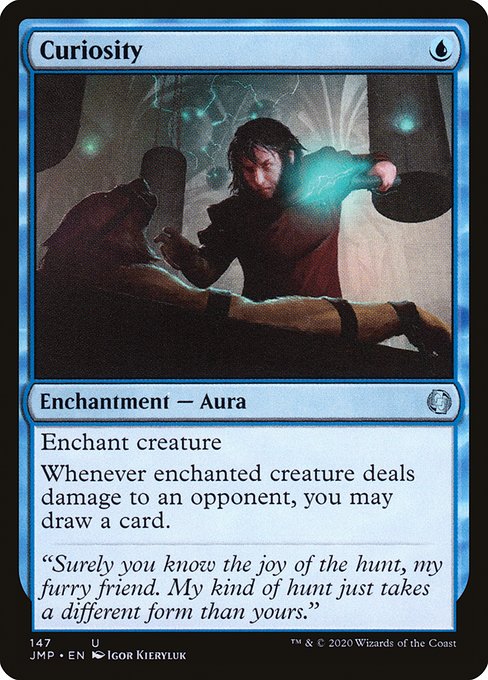
Curiosity card art
Live Play Data

Curiosity

{U} · Enchantment — Aura · Jumpstart (JMP)
4%
Live Inclusion
Times Brought
678
Decks Running
363
Median Cast Turn
6.0
Drawn → Played
64%
Format

36% of games where Curiosity resolved ended in a win for the caster, a +13.0 percentage-point lift over the 23% baseline recorded when the card never left the library.

Curiosity sits in 363 of the 8991 distinct decks tracked on Playgroup Live, a specialist card rather than a universal staple. When it does resolve, the win-rate signal is one of the stronger ones in our dataset: 36% for casters against a 23% baseline, a +13.0 percentage-point gap that clears its own standard error comfortably. Treat this as a directional finding. Sample sizes are real but not enormous, and the card naturally clusters in decks built to exploit it.

The play pattern reflects how deliberate Curiosity players are. Median first cast lands on turn 6.0, well past the card's 1-mana cost. Of instances drawn and then cast, players held it a median of one turn before committing. 45% of drawn-and-cast copies were played on the same turn they were drawn, meaning many players wait for the right creature target rather than slamming it immediately. 64% of drawn copies ultimately reached the stack, which is solid for an Aura that demands a living creature to be useful.

The commander distribution tells the broader story. Curiosity anchors damage-triggers strategies: Niv-Mizzet loops, Ghyrson Starn pingers, Nekusar group-slug, and the growing cluster of Final Fantasy and Marvel commanders that deal incidental damage. It is legal in Commander, Duel Commander, Legacy, Modern, Vintage, and most other non-rotating formats.

At a glance
  • 4% of tracked Commander decks include Curiosity
  • 64% of drawn copies were cast before the game ended
  • T6.0 median first-cast turn, reflecting deliberate creature-targeting
  • 36% win rate in games where Curiosity resolved
  • +13.0pp win-rate lift over the library baseline, a consistent early signal
  • 54% battlefield stickiness once Curiosity is cast

First-cast turn

n=122
1%
T1
3%
T2
16%
T3
14%
T4
16%
T5
39%
T6-9
11%
T10+
Median 6.0 P25 4 · P75 8 · max 12
On curve 1% (1 / 122 cast on T1) Cast same turn as drawn 45%

The "good card" funnel

679 brought · 331 players
Brought to game
679
Ever drawn
190
Reached battlefield
122
Still on board at game end
66
64%

Of 679 Curiosity copies brought to games, 190 were drawn, 122 of those were cast, and just over half remained on the battlefield at game's end, a stickiness figure that reflects how often opponents answer the enchantment once it starts generating value.

≥ +4.3pp

Players who cast this card win 36% of the time (n=110) , vs 23% when it never left the library (n=423).

When players drew this card but left it in hand, they won 31% (n=59) — about the same as leaving it in the library. Those players survived long enough to draw it, so the gap above is about the card resolving, not just about surviving.

Observed gap +13.0pp; 95% confidence interval +4.3pp to +21.8pp. Correlational, not causal: powerful payoffs also get cast more often in games you are already winning.

Final zone distribution

202 instances
2.5%
Library
32.7%
Battlefield
32.7%
Graveyard
5.9%
Exile

Most Curiosity copies finish in the graveyard or on the battlefield, with very few stranded in the library. That is an artifact of how the card is played: it only enters a deck with a clear plan to cast it, so it rarely sits unnoticed in the 99.

Commanders that played this card

in tracked games

The commander list skews toward damage-trigger builds, with Y'shtola and Vivi leading by raw count. The spread across Izzet, Grixis, and multicolor commanders shows Curiosity is not locked into a single archetype.

Card text
Curiosity card

Curiosity

{U}
Enchantment — Aura
Enchant creature Whenever enchanted creature deals damage to an opponent, you may draw a card.
Jumpstart (JMP) · Uncommon · Illustrated by Igor Kieryluk

Frequently Asked

How often is Curiosity drawn in a Commander game?
Across 666 tracked games where Curiosity was in the deck, it was drawn 28% of the time. That is typical for a singleton in a 100-card deck. Of the 190 instances that reached a player's hand, 64% were eventually cast. The remainder were mostly cards drawn too late, or in games where a suitable creature target was never available.
What turn does Curiosity usually get cast?
Median first cast is turn 6.0, with the interquartile range running from turn 4 to turn 8. Despite costing only 1 mana, Curiosity is rarely cast in the opening turns. Players wait for a creature worth enchanting. The 45% same-turn cast rate confirms that deliberate sequencing. When the right creature is already on the battlefield, players commit immediately.
Does casting Curiosity actually improve your chances of winning?
What we see so far is directional and encouraging. Games where Curiosity resolved show a 36% win rate, compared to 23% in games where it stayed in the library untouched. That is a +13.0 percentage-point gap across 110 cast observations and 423 library observations. Both buckets are large enough to take seriously. The card naturally clusters in decks designed to break it, so some of the lift reflects deck quality rather than the card alone.
Which commanders most commonly run Curiosity?
Y'shtola, Night's Blessed leads the raw deck count in our dataset, followed closely by Vivi Ornitier and Ghyrson Starn, Kelermorph. The older guard of damage-trigger commanders, Niv-Mizzet and Nekusar, are also well represented. The pattern is consistent: Curiosity finds a home wherever a commander deals damage as a repeated trigger, turning each hit into a card draw.
Is Curiosity banned anywhere?
Curiosity is legal in Commander, Duel Commander, Legacy, Modern, Vintage, Historic, Timeless, Gladiator, and several other formats. It is not legal in Standard, Pioneer, Pauper, or Pauper Commander. It has no bans in the formats where it is legal, though its combo potential with Niv-Mizzet, Parun (infinite loops) is a well-known interaction that shapes how opponents respond to it.
How concentrated is the Curiosity data among a small group of players?
The data is well spread. 331 distinct players have brought Curiosity to a tracked game, and the single heaviest contributor accounts for 28% of all instances, well under the 30% threshold where concentration becomes a concern. This breadth strengthens the read on the card's performance, even though Playgroup Live's overall dataset is still growing.