bolt Game Changer on the MTG Commander Game Changers list
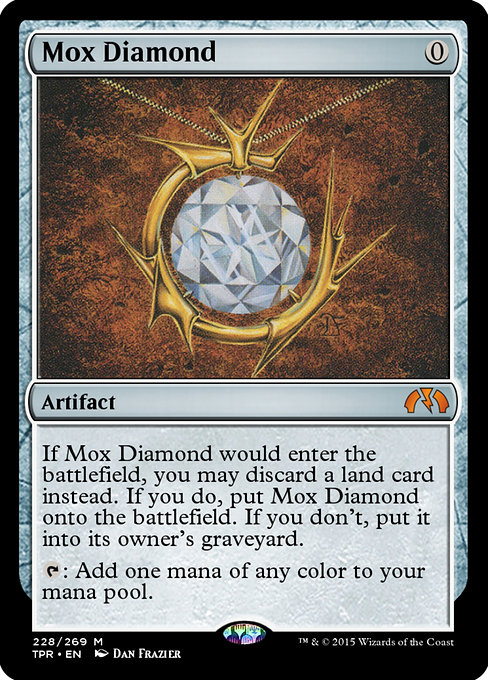
Mox Diamond card art
Live Play Data

Mox Diamond

{0} · Artifact · Tempest Remastered (TPR)
3%
Live Inclusion
Times Brought
764
Decks Running
373
Median Cast Turn
4
Drawn → Played
71%
Format

Mox Diamond appears in 3% of multiplayer Commander decks tracked on Playgroup Live. When drawn, 71% of copies reach the battlefield, with a median first-cast turn of 4.

Mox Diamond is a free mana rock with a real cost: discard a land to put it into play, or it goes straight to the graveyard. In 536 tracked multiplayer Commander games, 373 of 11359 distinct decks brought it to the table, an inclusion rate of 3%. That selectivity reflects the card's steep deckbuilding constraint: it rewards land-heavy and ramp-dense builds, and punishes lists that can't reliably spare a land in their opening hand.

Of 167 drawn copies, 71% were cast before the game ended. The mode first-cast turn is 1, meaning players who open with Mox Diamond and a spare land play it immediately. Median first-cast lands on turn 4, pulled later by copies drawn mid-game when a land discard is harder to stomach. Battlefield stickiness sits at 76%, typical for a low-cost artifact that draws removal only when a player is desperate.

The commander distribution is notably spread. 212 distinct players have brought Mox Diamond to a tracked game, and no single player accounts for more than 22% of the dataset. Five-color commanders dominate the top slots, which makes sense: colorless mana acceleration that fixes any color is most valuable when your commander has the most demanding cost.

At a glance
  • 3% of tracked multiplayer Commander decks include Mox Diamond
  • T4 median first-cast turn, with mode on turn 1 for opening-hand copies
  • 71% of drawn copies reach the battlefield before the game ends
  • 76% battlefield stickiness once it resolves
  • 212 distinct players have brought this card to a tracked game, a well-spread dataset

First-cast turn

n=119
32%
T1
4%
T2
13%
T3
8%
T4
11%
T5
25%
T6-9
8%
T10+
Median 4 P25 1 · P75 7 · max 17
Cast same turn as drawn 75%

The "good card" funnel

764 brought · 212 players
Brought to game
764
Ever drawn
167
Reached battlefield
119
Still on board at game end
90
71%

Of 764 Mox Diamonds brought to multiplayer games, 167 were drawn, 119 of those were cast, and 76% of resolved copies survived to end of game.

≥ -9.0pp

Players who cast this card win 28% of the time (n=114) , vs 29% when it never left the library (n=531).

When players drew this card but left it in hand, they won 36% (n=47) — about the same as leaving it in the library. Those players survived long enough to draw it, so the gap above is about the card resolving, not just about surviving.

Observed gap -1.0pp; 95% confidence interval -9.0pp to +7.0pp. Correlational, not causal: powerful payoffs also get cast more often in games you are already winning.

Final zone distribution

196 instances
6.1%
Library
45.9%
Battlefield
21.4%
Graveyard
8.7%
Exile

Most Mox Diamond copies end their game on the battlefield or in the graveyard, reflecting its zero mana cost and the natural attrition of artifact removal over a long Commander game.

Commanders that played this card

in tracked games

Five-color commanders dominate the top slots, a consistent signal that Mox Diamond's any-color mana production is most valued in decks with demanding, multi-color mana bases.

Frequently Asked

How often is Mox Diamond drawn in a Commander game?
In 536 tracked multiplayer games where Mox Diamond was in the deck, it was drawn 22% of the time. That is normal for a singleton in a 100-card deck. Of 167 copies that reached a player's hand, 71% were cast. Copies that go uncast are most often drawn late in the game when the discard cost is prohibitive or the game ends before casting priority arrives.
What turn does Mox Diamond usually hit the battlefield?
The median first-cast turn in multiplayer games is 4, but the distribution is strongly bimodal. Turn 1 is the single most common cast turn, driven by players who open with the card and a surplus land. After that, casts spread across turns 3 through 7 as copies drawn mid-game get played when a land can be spared. The mean is pulled higher by the occasional very late cast.
Is Mox Diamond banned anywhere?
Mox Diamond is banned in Duel Commander (the French one-on-one variant) and in The Lord of the Rings Commander format. It is legal in multiplayer Commander, Legacy, Vintage, Premodern, Oathbreaker, and PreDH. It is not legal in Modern, Pioneer, Standard, Pauper, or any Brawl variant. The Duel Commander ban reflects how much more powerful free mana acceleration is in a two-player, 20-life format.
Which commanders most commonly pair with Mox Diamond?
In the Playgroup Live multiplayer dataset, five-color commanders claim the top slots. The Ur-Dragon and Esika, God of the Tree lead with 12 and 10 decks respectively, followed by Kinnan, Bonder Prodigy and Kenrith, the Returned King. The pattern is consistent: commanders with heavy or multi-color mana demands benefit most from a free rock that produces any color. The dataset is spread across 212 unique players, so this reflects real deckbuilding diversity rather than one player's choices.
Does casting Mox Diamond actually correlate with winning?
The cast-vs-library win-rate delta is a small negative number in the current multiplayer sample, meaning decks that cast Mox Diamond do not show a measurable win-rate lift over decks where it sat in the library. Both the cast bucket (114 observations) and library bucket (531 observations) are directional rather than conclusive at Playgroup Live's current dataset size. The more reliable read is that Mox Diamond's value is tempo: it accelerates the early game, which shows up in board states rather than win-rate columns.
Why does a free artifact that makes any color of mana have a discard-land requirement?
Mox Diamond was printed in Stronghold (1996) as a nod to the original Alpha Mox cycle, but with a built-in cost to prevent it from being a strictly free piece of acceleration. Discarding a land is a real price: it reduces your land count, can strand future draws, and is painful in games where you need every land drop. In Commander, land-heavy strategies, ramp builds, and decks with high land counts can absorb the cost more easily, which is why the card clusters in decks built around consistent land play.