
collections_bookmark Part of Bloomburrow
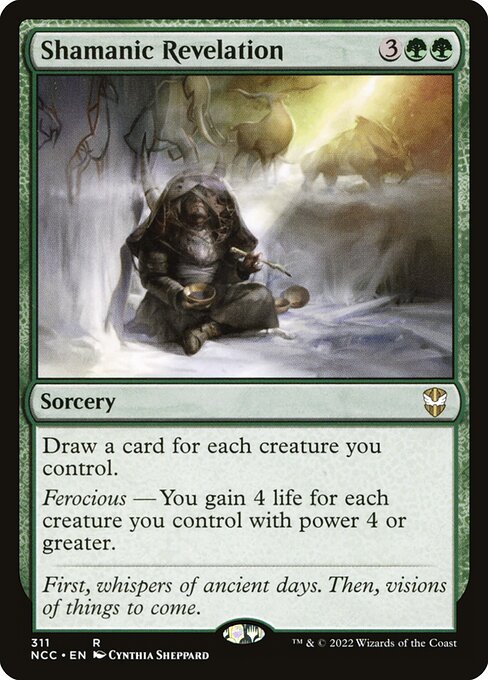
Shamanic Revelation card art
Live Play Data

Shamanic Revelation

{3} {G} {G} · Sorcery · New Capenna Commander (NCC)
8%
Live Inclusion
Times Brought
1229
Decks Running
595
Median Cast Turn
7.0
Drawn → Played
47%
Format

Shamanic Revelation resolves in 38% of the games where it's cast on Playgroup Live, a +15.2 percentage-point lift over the baseline win rate, across 115 tracked casts.

Shamanic Revelation sits in 8% of the Commander decks tracked on Playgroup Live. That narrow slice reflects its heavy deck-building constraint: you need a board full of creatures to get meaningful value from a 5-mana sorcery that draws one card per creature.

When it does resolve, the numbers reward the patience. Win rate when cast is 38%, compared to 23% for games where it stayed in the library. That +15.2 point gap is a consistent signal across 115 cast observations, though the sample is still growing, so treat it as directional. Median first-cast turn lands on turn 7.0, well past the curve for a 5-mana spell, which tells you players are waiting until they have a wide board rather than jamming it on curve.

The commander spread is broad. 511 distinct players have brought Shamanic Revelation to a tracked game, and no single contributor accounts for more than a small fraction of instances. Token-wide and go-wide strategies dominate the top of the commander list, from Golgari token engines to mono-green swarm builds, underlining that this card rewards quantity on the board above almost everything else.

At a glance
  • 8% of tracked Commander decks include Shamanic Revelation
  • T7.0 median first-cast turn, well behind curve, players wait for a wide board
  • 47% of drawn copies reached the cast step before the game ended
  • 38% win rate in games where Shamanic Revelation resolved
  • +15.2pp win-rate lift vs. games where it stayed in the library
  • 511 distinct players have brought it to a tracked game, data well-spread

First-cast turn

n=124
0%
T1
0%
T2
2%
T3
4%
T4
11%
T5
65%
T6-9
17%
T10+
Median 7.0 P25 6 · P75 9 · max 16
On curve 18% (14 / 124 cast on T5) Cast same turn as drawn 20%

The "good card" funnel

1229 brought · 511 players
Brought to game
1229
Ever drawn
262
Reached battlefield
124
Still on board at game end
6
47%

Of 1229 copies brought to games, 262 were drawn and 124 of those were cast, with 47% of drawn copies making it to resolution before the game ended.

≥ +6.6pp

Players who cast this card win 38% of the time (n=115) , vs 23% when it never left the library (n=836).

When players drew this card but left it in hand, they won 27% (n=121) — about the same as leaving it in the library. Those players survived long enough to draw it, so the gap above is about the card resolving, not just about surviving.

Observed gap +15.2pp; 95% confidence interval +6.6pp to +23.8pp. Correlational, not causal: powerful payoffs also get cast more often in games you are already winning.

Final zone distribution

284 instances
2.5%
Library
2.1%
Battlefield
55.3%
Graveyard
3.5%
Exile

The overwhelming majority of Shamanic Revelation copies finish in the graveyard after resolving, as expected for a sorcery. The small library residual reflects copies that were simply never drawn across 1229 deck participations.

Commanders that played this card

in tracked games

The commander list spans 511 distinct players with no single contributor dominating, a sign that Shamanic Revelation's home is a genuine archetype pattern rather than one person's pet deck.

Card text
Shamanic Revelation card

Shamanic Revelation

{3} {G} {G}
Sorcery
Draw a card for each creature you control. Ferocious — You gain 4 life for each creature you control with power 4 or greater.
New Capenna Commander (NCC) · Rare · Illustrated by Cynthia Sheppard

Frequently Asked

How often is Shamanic Revelation drawn in a Commander game?
Across 1169 tracked multiplayer Commander games where Shamanic Revelation was in the deck, it was drawn 21% of the time. That is typical for a singleton in a 100-card deck. Of the 262 copies that reached a hand, 47% were cast before the game ended. The remainder is largely a game-length effect: copies drawn in the late turns of a fast game often never find a window to resolve.
What turn does Shamanic Revelation usually get cast?
Median first-cast turn is 7.0. The p25-p75 range runs from turn 6 to turn 9, which is late for a 5-mana spell. Only 18% of casts landed on turn 5 (the card's mana value). Most players are deliberately waiting until they control enough creatures to make the draw worthwhile, rather than casting it on curve with an empty or near-empty board.
Does casting Shamanic Revelation actually improve your odds of winning?
What we see so far is a +15.2 percentage-point difference in win rate between games where it resolved (38%) and games where it never left the library (23%). The cast bucket has 115 observations and the library bucket 836. The lower bound of the confidence interval is positive, which is an encouraging early signal, but the sample is still too small to call this a definitive effect. Treat it as directional.
Which commanders most often run Shamanic Revelation?
On Playgroup Live, Witherbloom the Balancer and Hazel of the Rootbloom lead the multiplayer top commanders list by deck count, followed closely by Shroofus Sproutsire and The Unbeatable Squirrel Girl. The pattern is consistent: Shamanic Revelation clusters in token-wide and go-wide strategies across Golgari, mono-green, and Gruul color identities, where a resolved copy on a full board can refill an entire hand in one shot.
Is Shamanic Revelation legal in Commander and other formats?
Shamanic Revelation is legal in Commander, Legacy, Modern, Pioneer, Vintage, Historic, Timeless, Duel Commander, Oathbreaker, Gladiator, and Brawl. It is not legal in Standard, Pauper, or Pauper Commander. There are no active bans in any of those legal formats as of the card's current rules entry.
How quickly do players cast Shamanic Revelation after drawing it?
Of 115 cast instances with hand-tracking data, the median delay between drawing and casting is 3 turns. Only 20% of drawn copies were cast on the same turn they were drawn. That low same-turn rate confirms what the cast-turn distribution shows: players are holding the card and waiting for the right board state rather than deploying it immediately.