
collections_bookmark Part of Commander Masters
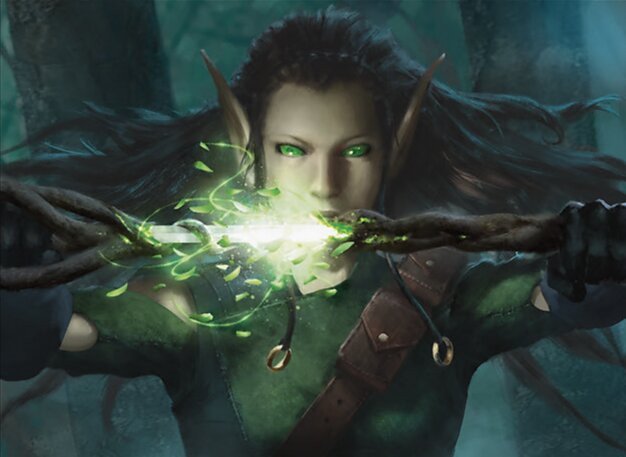
Sword of the Animist card art
Live Play Data

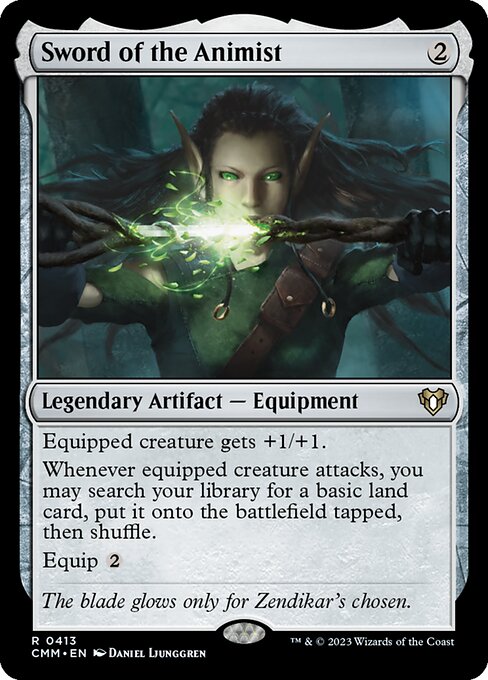
Sword of the Animist

{2} · Legendary Artifact — Equipment · Commander Masters (CMM)
5%
Live Inclusion
Times Brought
876
Decks Running
445
Median Cast Turn
4
Drawn → Played
73%
Format

Sword of the Animist appears in 5% of tracked Commander decks on Playgroup Live, and 73% of drawn copies reach the battlefield, with a median first-cast turn of 4.

Sword of the Animist shows up in 5% of the Commander decks tracked on Playgroup Live, spread across 445 distinct decklists out of 8378 in the dataset. Its colorless identity makes it a genuine format-wide option: no color requirement locks it out of any deck.

The card's attack trigger is the draw. Every swing with the equipped creature can fetch a basic land from the library, compounding ramp turn after turn. That engine explains why players prioritize casting it: 73% of drawn copies make it to the battlefield before the game ends. Median first cast lands on turn 4, squarely in the mid-game window where an extra land per combat has the most leverage. Once it resolves, stickiness is high: 83% of cast copies finish the game on the battlefield.

The commander distribution is notably broad. Cloud, Ex-SOLDIER leads the Playgroup Live sample by deck count, but Sword of the Animist appears across attack-focused builds in white, green, and red shells, and even in some mono-colored lists where reliable ramp is hardest to find. The data so far is a consistent early signal rather than a locked-in verdict, and the 373 unique players in the sample give it solid spread.

At a glance
  • 5% of tracked Commander decks include Sword of the Animist
  • 73% of drawn copies reach the battlefield before the game ends
  • T4 median first-cast turn across tracked games
  • 83% battlefield stickiness once cast
  • 373 unique players have brought it to a tracked game, indicating broad adoption
  • 29% normalized win rate in games where Sword of the Animist resolved

First-cast turn

n=161
4%
T1
21%
T2
11%
T3
17%
T4
14%
T5
26%
T6-9
7%
T10+
Median 4 P25 3 · P75 6 · max 14
On curve 25% (34 / 161 cast on T2) Cast same turn as drawn 39%

The "good card" funnel

881 brought · 373 players
Brought to game
881
Ever drawn
221
Reached battlefield
161
Still on board at game end
133
73%

Of 881 copies brought to games, 221 were drawn, 161 of those were cast, and 83% of cast copies finished the game on the battlefield, a tight conversion chain from deck slot to active ramp engine.

≥ -0.2pp

Players who cast this card win 29% of the time (n=155) , vs 22% when it never left the library (n=593).

When players drew this card but left it in hand, they won 30% (n=58) — about the same as leaving it in the library. Those players survived long enough to draw it, so the gap above is about the card resolving, not just about surviving.

Observed gap +7.1pp; 95% confidence interval -0.2pp to +14.3pp. Correlational, not causal: powerful payoffs also get cast more often in games you are already winning.

Final zone distribution

243 instances
1.6%
Library
54.7%
Battlefield
18.5%
Graveyard
5.8%
Exile

Most copies finish the game on the battlefield, a strong result for an Equipment that must survive equip costs and combat. The library bucket is near-empty because the card is counted from the moment it is observed, not the moment it enters play.

Commanders that played this card

in tracked games

Cloud, Ex-SOLDIER leads the Playgroup Live sample by raw deck count, but the list spans white, green, and red attack-focused commanders, confirming that Sword of the Animist's colorless identity gives it genuinely broad reach.

Frequently Asked

How often is Sword of the Animist drawn in a Commander game?
Across 761 tracked multiplayer Commander games where the card was in the deck, it was drawn 25% of the time. That is typical for a singleton in a 100-card deck. Of 221 instances that reached a player's hand, 73% were cast before the game ended. The remainder were mostly cases where the game concluded before the player found a window to equip.
What turn does Sword of the Animist usually get cast?
The median first-cast turn is 4, with a mode of turn 2 in the Playgroup Live data. The distribution has a cluster of early casts from opening-hand draws and a longer tail into turns 6-9. On-curve casting (turn 2 for a 2-mana card) happens in a minority of games, which mostly reflects that many copies are drawn mid-game rather than kept in the opening hand. When players do have it in hand, they tend to hold it about one turn before casting, consistent with looking for equip mana.
Does resolving Sword of the Animist actually improve your win rate?
In tracked multiplayer games, the normalized win rate when Sword of the Animist resolved is 29%, versus 22% when the card never left the library. That is a directional positive gap. Both sample sizes are large enough to treat this as a meaningful early signal, though the confidence interval on the delta overlaps zero at the low end, so interpret it as consistent with a real effect rather than proven. Playing the card is associated with better outcomes; it is not the whole story.
Is Sword of the Animist legal in Commander?
Yes. Sword of the Animist is legal and unrestricted in Commander, as well as in Duel Commander, Legacy, Modern, Pioneer, Vintage, and Oathbreaker. It is not legal in Standard, Brawl, Alchemy, Pauper, or Pauper Commander.
Which commanders most often run Sword of the Animist?
On Playgroup Live, Cloud, Ex-SOLDIER leads the tracked sample with the most decks including the card, followed by T'Challa, the Black Panther and Giada, Font of Hope. The common thread is attack-based commanders that can trigger the land-fetch ability consistently every combat step. Its colorless identity means any aggressive or creature-heavy deck in any color combination can consider it.
How concentrated is the Sword of the Animist data across players?
The Playgroup Live sample is well spread. 373 distinct players have brought Sword of the Animist to a tracked game, and the single heaviest contributor accounts for only 2% of all instances. That low concentration is a strength of this dataset: the play patterns we observe reflect a wide range of pilots and deck archetypes rather than one player's repeated sessions.