collections_bookmark Part of Streets of New Capenna
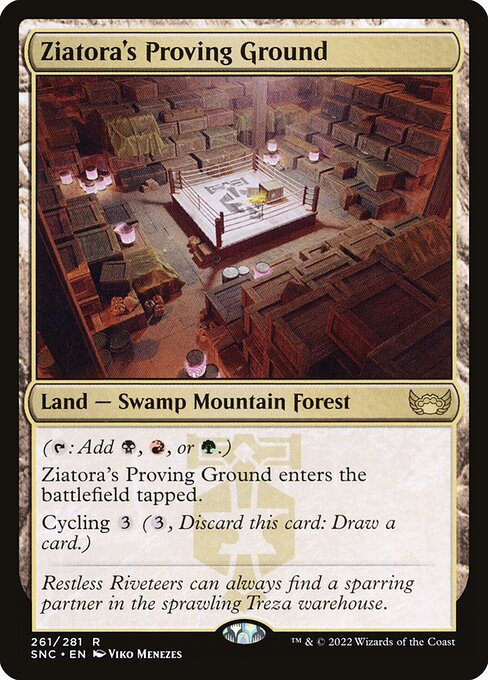
Ziatora's Proving Ground card art
Live Play Data

Ziatora's Proving Ground

Land — Swamp Mountain Forest · Streets of New Capenna (SNC)
20%
Live Inclusion
Times Brought
734
Decks Running
346
Median Cast Turn
3.0
Drawn → Played
86%
Format

20% of tracked Commander decks run Ziatora's Proving Ground, and 86% of drawn copies reach the battlefield, with a median first-cast turn of 3.0.

Ziatora's Proving Ground sits in 20% of tracked Commander decks on Playgroup Live, making it one of the more-played triome lands among Jund (black-red-green) color identities. It appears in 346 of the 1731 distinct decks that have played a tracked game.

The standout number is draw-to-play: 86% of drawn copies reach the battlefield before the game ends. That rate is higher than most utility lands and reflects the basic reality that a tapped triome is almost never a card you sit on. Players play it the same turn they draw it 70% of the time. Median first cast lands on turn 3.0, consistent with an early-turn land drop rather than a late-game topdeck. The cycling clause at {3} provides a floor: when mana fixing is irrelevant, it converts into a fresh draw.

The commander distribution is broad. No single commander dominates; the top entries span both pure Jund commanders and five-color piles that simply need every piece of fixing they can get. That spread across 312 distinct players and multiple archetype types is an early signal that the card earns its slot on raw utility rather than synergy with one particular strategy.

At a glance
  • 20% of tracked Commander decks include Ziatora's Proving Ground
  • 86% of drawn copies reach the battlefield before the game ends
  • T3.0 median first-cast turn
  • 70% of drawn copies are played the same turn they are drawn
  • 91% battlefield stickiness once the land enters play
  • 312 distinct players have brought this card to a tracked game

First-cast turn

n=254
29%
T1
18%
T2
9%
T3
11%
T4
9%
T5
19%
T6-9
4%
T10+
Median 3.0 P25 1 · P75 5 · max 12
Cast same turn as drawn 70%

The "good card" funnel

735 brought · 312 players
Brought to game
735
Ever drawn
296
Reached battlefield
254
Still on board at game end
230
86%

Of 735 copies brought to tracked games, 296 were drawn, 254 of those were played to the battlefield, and the overwhelming majority stayed there through end of game.

≥ -4.5pp

Players who cast this card win 27% of the time (n=235) , vs 25% when it never left the library (n=351).

When players drew this card but left it in hand, they won 24% (n=36) — about the same as leaving it in the library. Those players survived long enough to draw it, so the gap above is about the card resolving, not just about surviving.

Observed gap +2.1pp; 95% confidence interval -4.5pp to +8.7pp. Correlational, not causal: powerful payoffs also get cast more often in games you are already winning.

Final zone distribution

315 instances
2.5%
Library
73.0%
Battlefield
13.0%
Graveyard
1.9%
Exile

The vast majority of Ziatora's Proving Grounds end the game on the battlefield, confirming that once it enters play it stays in play for the duration. The library bucket is very small, reflecting how rarely this land goes completely unseen in a game.

Commanders that played this card

in tracked games

The top-commander list spans Jund three-color builds and five-color piles alike, with no single commander dominating. That spread signals the card earns inclusion as a generic fixing piece rather than a payoff for any one commander.

Card text
Ziatora's Proving Ground card

Ziatora's Proving Ground

Land — Swamp Mountain Forest
({T}: Add {B}, {R}, or {G}.) This land enters tapped. Cycling {3} ({3}, Discard this card: Draw a card.)

Streets of New Capenna (SNC) · Rare · Illustrated by Viko Menezes

Frequently Asked

How often is Ziatora's Proving Ground drawn in a Commander game?
In 697 tracked multiplayer games where this land was in the deck, it was drawn 40% of the time. That is above the baseline for a singleton in a 100-card deck, partly because land-heavy hands are kept more often. Of 296 instances that reached a hand, 86% were played before the game ended.
What turn does Ziatora's Proving Ground typically enter the battlefield?
Median first-cast turn is 3.0, which aligns with the early land-drop window. The distribution clusters heavily in turns 1 and 2, meaning a large share of casts come from opening hands. The p75 lands on turn 5, so later draws are common too, but the card is not primarily a mid-game topdeck play.
Is Ziatora's Proving Ground legal in Commander?
Yes. Ziatora's Proving Ground is legal in Commander, as well as Legacy, Modern, Pioneer, Vintage, Historic, and several other formats. It is not legal in Standard, Pauper, or Pauper Commander. The card was printed in Streets of New Capenna as a rare.
Which commanders most often run Ziatora's Proving Ground?
The top commanders on Playgroup Live include both dedicated Jund commanders such as Henzie "Toolbox" Torre, Korvold Fae-Cursed King, and Indoraptor the Perfect Hybrid, and five-color commanders like The Ur-Dragon and Jodah the Unifier who treat it as one piece of a broad fixing package. The spread across archetypes reflects the land's role as a pure mana-fixing tool rather than a synergy piece.
Does casting Ziatora's Proving Ground improve your win rate?
In 235 participations where the land reached the battlefield, the normalized win rate was 27%. In 351 participations where it stayed in the library, the rate was 25%. The delta is small and the confidence interval crosses zero, so treat this as directional at best. Decks that play the land are not meaningfully better or worse than decks that don't draw it.
Why does Ziatora's Proving Ground enter tapped, and does that matter in Commander?
As a triome from Streets of New Capenna, entering tapped is the explicit cost for accessing three colors from one land. In Commander, where the early game is typically slower and establishing a mana base matters more than tempo loss on a single turn, most players accept that trade readily. The cycling clause at {3} adds a secondary use case: in games where all three colors are already covered, the land can cycle into a more relevant card rather than simply clogging an already-full mana base.