
collections_bookmark Part of Dominaria United
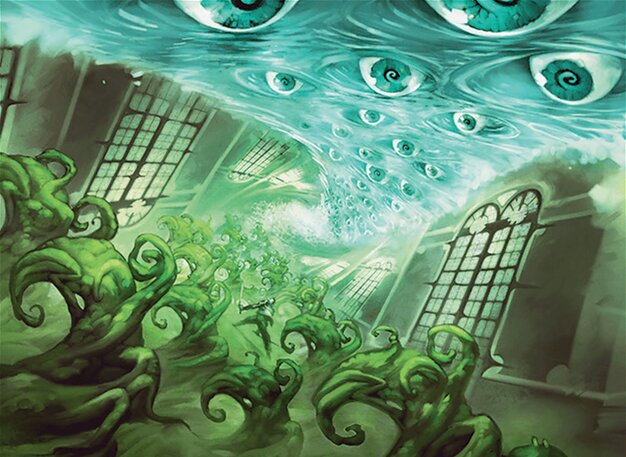
Growth Spiral card art
Live Play Data

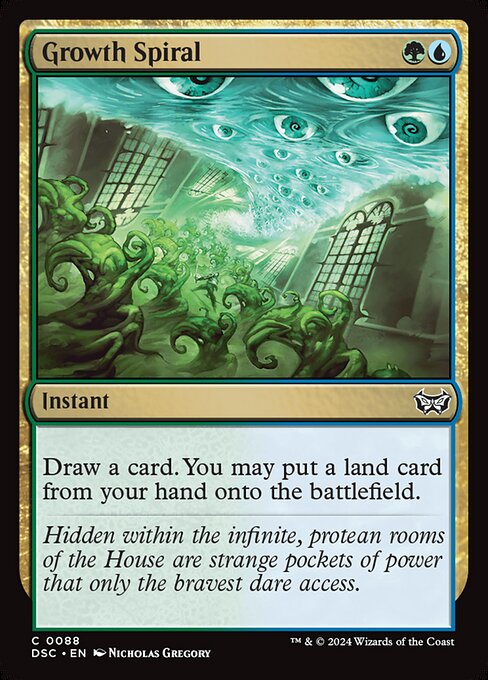
Growth Spiral

{G} {U} · Instant · Duskmourn: House of Horror Commander (DSC)
17%
Live Inclusion
Times Brought
936
Decks Running
524
Median Cast Turn
5
Drawn → Played
69%
Format

17% of tracked Commander decks with green and blue access run Growth Spiral. When drawn, it resolves 69% of the time, with a median first-cast turn of 5.

Growth Spiral sits in 17% of the Commander decks that have played a tracked game on Playgroup Live. That's 524 decks out of 3162, a consistent presence across Simic and multicolor shells that want early land acceleration without sacrificing card equity.

The card does two things at once: it replaces itself and it can accelerate your mana by one land drop. That combination is why 69% of drawn copies reach resolution. The median first cast lands on turn 5, which is later than the mana cost suggests. Most copies that land after turn 4 are drawn mid-game and slotted in opportunistically rather than saved deliberately. Of the 175 casts on record, 30% of those games were won by the caster, a directional edge over the 23% win rate seen when the card never leaves the library. Both samples are early signal, not a proven causal claim.

The commander distribution is broad. Hakbal of the Surging Soul and Aesi, Tyrant of Gyre Strait lead the top-10 list, both land-synergy commanders that benefit directly from an extra land drop. Growth Spiral also appears in five-color and Temur shells, showing it earns its slot beyond pure Simic builds. The dataset is spread across 451 distinct players, with no single player accounting for more than a small fraction of instances, which gives these numbers reasonable diversity.

At a glance
  • 17% of tracked Commander decks include Growth Spiral
  • 27% draw rate per game, typical for a singleton in a 100-card deck
  • 69% of drawn copies were cast before the game ended
  • T5 median first-cast turn across 175 observed casts
  • 30% win rate in games where Growth Spiral resolved, vs 23% when it stayed in the library
  • 451 distinct players have brought Growth Spiral to a tracked game

First-cast turn

n=175
6%
T1
17%
T2
11%
T3
10%
T4
13%
T5
37%
T6-9
7%
T10+
Median 5 P25 3 · P75 7 · max 17
On curve 23% (29 / 175 cast on T2) Cast same turn as drawn 48%

The "good card" funnel

939 brought · 451 players
Brought to game
939
Ever drawn
255
Reached battlefield
175
Still on board at game end
2
69%

Of 939 Growth Spirals brought to games, 255 were drawn, 175 of those were cast, and nearly all resolved copies moved immediately to the graveyard as the instant resolved.

≥ -0.6pp

Players who cast this card win 30% of the time (n=160) , vs 23% when it never left the library (n=588).

When players drew this card but left it in hand, they won 32% (n=78) — about the same as leaving it in the library. Those players survived long enough to draw it, so the gap above is about the card resolving, not just about surviving.

Observed gap +6.7pp; 95% confidence interval -0.6pp to +14.0pp. Correlational, not causal: powerful payoffs also get cast more often in games you are already winning.

Final zone distribution

284 instances
3.5%
Library
0.7%
Battlefield
69.7%
Graveyard
6.0%
Exile

Almost all Growth Spirals end in the graveyard after resolving, as expected for an instant. The small library count reflects copies that were never drawn in observed participations, a structural feature of 100-card singleton rather than a judgment on the card.

Commanders that played this card

in tracked games

Hakbal and Aesi sit atop the list with the largest deck counts, but the spread across ten commanders in multiple color identities shows Growth Spiral is a format staple rather than a card tied to a single archetype.

Frequently Asked

How often is Growth Spiral drawn in a Commander game?
In 891 tracked games where Growth Spiral was in the deck, it was drawn 27% of the time. That rate is consistent with what you'd expect from a singleton in a 100-card deck. Of 255 instances that reached a player's hand, 69% were cast before the game ended. The remainder were largely a game-length effect: copies drawn in the late turns sometimes never get played before the game concludes.
What turn does Growth Spiral typically get cast?
Median first cast lands on turn 5, with the middle 50% of casts falling between turns 3 and 7. The mode in the distribution is turn 2, reflecting copies kept in opening hands and slammed early. The mean is pulled higher by copies drawn in the mid-to-late game. Because Growth Spiral costs 2 mana and 23% of casts landed exactly on curve, most copies reach the battlefield later than the card's mana value alone would suggest. Check the same-turn cast rate: 48% of drawn-and-cast copies were played the same turn they were drawn, so players do not tend to hold it deliberately.
Does casting Growth Spiral actually improve your win rate?
In 160 participations where Growth Spiral resolved, the caster's win rate was 30%. In 588 participations where it stayed in the library untouched, the win rate was 23%. The gap is +6.8 percentage points. Both buckets are meaningful in size, but the dataset is still early-stage. Treat this as a directional signal, not a statistically conclusive effect.
Which commanders run Growth Spiral most often?
Hakbal of the Surging Soul and Aesi, Tyrant of Gyre Strait lead the tracked commander list, both Simic land-matters commanders that reward an extra land drop directly. The top 10 also includes multicolor commanders like Aragorn, the Uniter and five-color shells, confirming Growth Spiral earns its slot wherever green and blue overlap, not only in dedicated landfall builds.
Is Growth Spiral legal in Commander?
Yes. Growth Spiral is legal in Commander, Duel Commander, Pauper Commander, Brawl, Pioneer, Modern, Legacy, Vintage, Pauper, and several other formats. It is not legal in Standard, Alchemy, Penny Dreadful, or PreDH. It has no banned status in any format where it is legal.
How concentrated is the Growth Spiral data across players?
The 891 tracked games where Growth Spiral appeared were spread across 451 distinct players. No single player accounts for more than a small slice of the total instances. That breadth is a relative strength of the dataset: the numbers are not skewed by one or two prolific users running the card repeatedly. The early-signal caveats still apply given overall game counts, but concentration is not a concern here.