
collections_bookmark Part of Bloomburrow
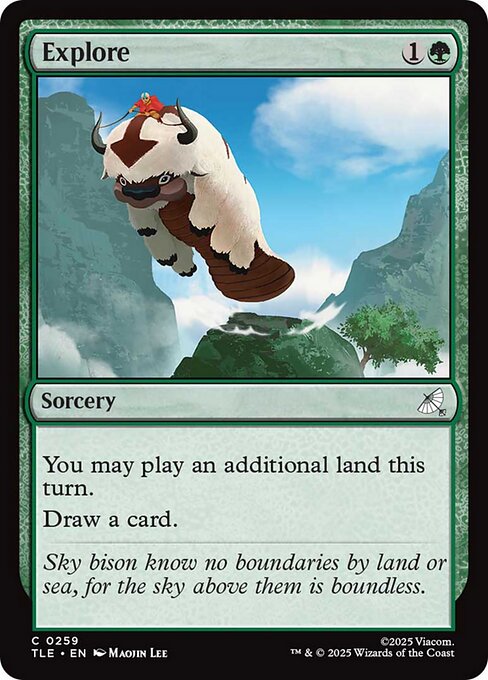
Explore card art
Live Play Data

Explore

{1} {G} · Sorcery · Avatar: The Last Airbender Eternal (TLE)
9%
Live Inclusion
Times Brought
863
Decks Running
479
Median Cast Turn
5.0
Drawn → Played
68%
Format

Explore appears in 9% of tracked Commander decks on Playgroup Live. When drawn, 68% of copies reach the cast step, with a median first-cast turn of 5.0.

Explore sits in 9% of Commander decks tracked on Playgroup Live, appearing across 479 of the 5406 distinct decks that have played a live game. For a 2-mana common with no standalone board presence, that share reflects a deliberate role: ramp that replaces itself.

The cast-vs-library win-rate delta is +14.9 percentage points, with the lower bound of the confidence interval clearing zero. That is the strongest directional signal we have that resolving Explore correlates with winning. Winning teams tend to resolve their cantrip ramp; teams that never draw it tend to fall behind. Both halves of the card, the land drop and the draw, contribute to that gap. The sample of 130 cast observations is large enough to take the direction seriously, though Playgroup Live's dataset is still growing and these figures should be read as early signal rather than settled fact.

The commander distribution skews toward land-matters and stompy strategies. Bello, Bard of the Brambles and Hakbal of the Surging Soul lead the list, both archetypes that reward extra land drops directly. The data is well-spread: 390 distinct players have brought Explore to a tracked game, and no single player accounts for more than 24% of all instances.

At a glance
  • 9% of tracked Commander decks include Explore
  • 68% of drawn copies are cast before the game ends
  • T5.0 median first-cast turn
  • +14.9pp win-rate lift when cast vs. when it stays in the library
  • 390 distinct players have brought Explore to a tracked game
  • 36% win rate in games where Explore was cast

First-cast turn

n=140
5%
T1
21%
T2
11%
T3
9%
T4
6%
T5
39%
T6-9
10%
T10+
Median 5.0 P25 2 · P75 7 · max 17
On curve 26% (29 / 140 cast on T2) Cast same turn as drawn 47%

The "good card" funnel

863 brought · 390 players
Brought to game
863
Ever drawn
205
Reached battlefield
140
Still on board at game end
0
68%

Of 863 Explores brought to tracked games, 205 were drawn, 140 of those were cast, and nearly all resolved to the graveyard as intended since Explore is a sorcery with no battlefield presence.

≥ +6.8pp

Players who cast this card win 36% of the time (n=130) , vs 21% when it never left the library (n=580).

When players drew this card but left it in hand, they won 29% (n=56) — about the same as leaving it in the library. Those players survived long enough to draw it, so the gap above is about the card resolving, not just about surviving.

Observed gap +14.9pp; 95% confidence interval +6.8pp to +23.0pp. Correlational, not causal: powerful payoffs also get cast more often in games you are already winning.

Final zone distribution

231 instances
3.9%
Library
74.5%
Graveyard
5.2%
Exile
16.5%
Hand

The vast majority of Explore copies finish in the graveyard, exactly as expected for a sorcery that resolves and goes to the yard. The small library residual represents copies that were never drawn across 814 tracked games.

Commanders that played this card

in tracked games

Bello and Hakbal tie at the top of the multiplayer list with 18 decks each, and the remaining commanders spread across green-blue landfall, green-red stompy, and five-color goodstuff archetypes, showing Explore has a home in most green strategies that care about land development.

Frequently Asked

How often is Explore drawn in a Commander game?
In 814 tracked multiplayer Commander games where Explore was in the deck, it was drawn 24% of the time. That is typical for a singleton in a 100-card deck. Of 205 instances that reached a player's hand, 68% were cast before the game ended. The remaining copies are almost always a game-length effect: Explore drawn very late often has no time to resolve before the game concludes.
What turn does Explore typically get cast?
Median first-cast turn is 5.0, with a mode of turn 2, meaning early opening-hand draws are the most common single cluster. The distribution is wide, however: the 25th percentile lands on turn 2 and the 75th on turn 7, so a meaningful share of Explores resolve well into the mid-game. The mean of 5.17 confirms the spread is right-skewed by occasional late draws.
Does casting Explore actually help you win?
The normalized win rate when Explore is cast is 36% across 130 observations. Win rate when it never leaves the library is 21% across 580 observations. The delta is +14.9 percentage points, and the statistical lower bound clears zero, making this a genuine directional signal in our dataset. Playgroup Live tracks around 814 multiplayer games, so treat this as early evidence rather than a definitive proof.
Is Explore legal in Commander?
Yes. Explore is legal in Commander, Duel Commander, Pauper Commander, Oathbreaker, Legacy, Modern, Vintage, Historic, and several other formats. It is not legal in Standard, Pioneer, Alchemy, or Penny Dreadful. There are no bans or restrictions in Commander.
Which commanders most commonly run Explore?
On Playgroup Live, Bello, Bard of the Brambles and Hakbal of the Surging Soul each lead the multiplayer list with 18 decks apiece, followed by Aesi, Tyrant of Gyre Strait with 15. All three reward extra land drops directly, making Explore's dual function of land-drop enablement and card replacement a tight fit. The Ur-Dragon and several five-color commanders also appear, consistent with Explore being a color-efficient ramp option in green-inclusive goodstuff shells.
How quickly do players cast Explore after drawing it?
Of the 130 cast observations where hand-to-cast timing was recorded, 47% were cast on the same turn the card was drawn. The median delay is 1 turn and the average is just over 1 turn. Explore is not universally slammed the moment it enters hand, which makes sense: players sometimes wait for a land to drop alongside it to maximize the extra land-drop text.